How to find your brand voice
Your brand voice is how your business sounds in writing and in speech. Find yours in about an hour and write it down so everyone who writes for you matches.
Your brand voice is how your business sounds in writing and in speech: the words you choose, the length of your sentences, the way you greet people and the way you apologize. Customers feel it before they can explain it. This lesson shows how to find yours in about an hour and how to write it down, so everyone who writes for you sounds like you.
Voice and tone are different things
Your voice is your personality. It stays the same everywhere. Your tone is your mood, and it changes with the situation. Think of a person you know well: she sounds like herself at a wedding and at a funeral, but she does not talk the same way at both. A café can be playful in a Friday post and serious and calm in an email about a billing mistake. The voice is the same. The tone moves.
You need to settle the voice first. Tone then follows from it, one situation at a time.
Four sliders to place your voice
The Nielsen Norman Group, a research firm that studies how people use websites, describes tone on four sliding scales. They give you a quick way to describe a voice without vague words.
- Formal or casual. Do you write "Dear customer" or "Hi there"?
- Serious or funny. Do you joke, or do you keep a straight face?
- Respectful or irreverent. Do you follow the rules of your industry, or poke fun at them?
- Matter-of-fact or enthusiastic. Do you state facts calmly, or show excitement?
Mark each one on a scale from 1 to 5. A family dentist might land at casual, serious, respectful and matter-of-fact. A skate shop might land at casual, funny, irreverent and enthusiastic. Neither is better. Each one fits its customers.
Find your voice in five steps
Step 1: Listen to your customers
Collect twenty real phrases from reviews, emails, direct messages and phone calls. Highlight how customers describe their problem and how they describe you. These are the words that work, because they are the ones people use. Mirror them. If customers say "fix a leak", do not write "plumbing remediation".
Step 2: Pick three traits, and add a "but not"
Choose three adjectives for how you sound, and pair each with a limit: friendly, but not silly; direct, but not pushy; expert, but not stuffy. The "but not" part is what makes the traits useful, because it tells a writer where to stop.
Step 3: Make a list of words
Write down the words you use and the words you avoid. Include your usual greeting and sign-off, whether you use contractions such as "we're" and "you'll", whether you use exclamation marks or emojis and how long your sentences run. Short is a good default.
Step 4: Write samples
Write the same message in your voice for five places: a home page line, a button, an email reply, a social post and an apology. Samples show people how the traits sound in practice, which a list of adjectives never does.
Step 5: Test it
Read everything out loud. If you would never say it to a customer standing in front of you, change it. Then show your samples to someone outside your business and ask them to guess your three traits. If they get two out of three, you are close.
Three voices on real sites
The home pages below are all concept designs we made. Each has a clear voice, and you can hear it in a single line of copy.
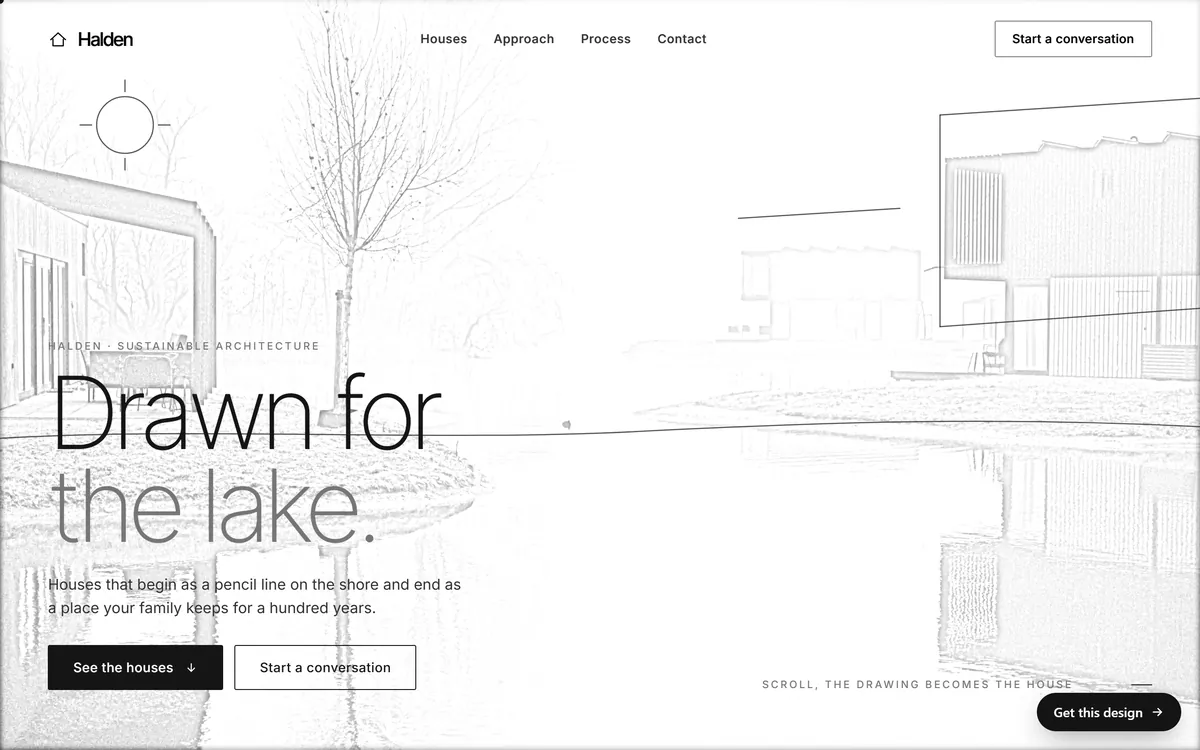
Halden, an architecture studio, is calm and precise. It writes one long, even sentence with a concrete picture in it: "Houses that begin as a pencil line on the shore and end as a place your family keeps for a hundred years." There are no exclamation marks and no big promises. The tone suits a client who is about to spend a lot of money on a house.
Good Dirt, a plant-based restaurant, is playful and direct. It speaks in short commands: "Build your own plate. Drag everything wherever you like." Nothing is stiff, and the voice invites you to touch the page.

Highway Roast, a canned coffee brand, is bold and factual. Its lines are short and built from facts: "Real cold brew, made without dairy." "Cold brewed, eighteen hours." "Twelve ounces, zero dairy." The voice sounds sure of itself because it never explains.

Rewrite examples
Most weak copy is not wrong. It is generic, and it could belong to any competitor. Here are four made-up examples, from an imaginary plumber, dentist and shop.
- Generic: "We provide high-quality plumbing solutions at competitive prices."
In a warm, plain voice: "Leak under the sink? Call us. We will find it and fix it." - Generic: "We are committed to excellence in oral healthcare."
In a calm, friendly voice: "We clean, we fix and we explain. No surprises, no lectures." - Generic: "We apologize for any inconvenience this may have caused."
In a human voice: "Sorry, we got your order wrong. The right one is on its way, and you do not need to send the other back." - Generic button: "Submit."
In your voice: "Send my request."
The rewrites are shorter, more concrete and written to a person. They also have a point of view, which is what a voice is.
How your tone shifts from one situation to the next
Your voice stays put, and your tone adapts. A few common moments show how.
- A happy customer. Warm and brief. Thank them by name and mention one detail from their visit.
- A complaint. Calm and specific. Say what went wrong, what you will do and when. Skip the jokes and the excuses.
- A question about price. Direct. Give the number or a range, and say what it includes. Dodging the question loses trust.
- A late payment. Polite, clear and firm. Name the invoice, the amount and the date you need it.
- A launch or a sale. More energy than usual, still in your own words.
In each case the customer should still feel they are hearing from the same business.
A five-question check before you publish
Run any new text through these questions. It takes a minute.
- Could a competitor put their name on this and nobody would notice?
- Does it sound like one of our three traits, and does it stay inside the "but not" limits?
- Would I say it out loud to a customer standing in front of me?
- Is every sentence about the customer's problem or benefit, and not about us?
- Is each claim something we can back up?
If the answer to any question is no, rewrite that sentence.
What goes on a voice sheet
A voice sheet fits on one page. Keep it short enough that you will actually read it.
- Your three traits, each with its "but not".
- Your four slider settings.
- Ten words you like to use, and ten you never use.
- How you greet people and how you sign off.
- Rules about contractions, exclamation marks, emojis and humor.
- Two or three sample sentences, including an apology.
- If you write in Spanish and English, the rules for each language.
Plain words beat big words
Use short sentences and common words. Write to "you", not to "customers" or "clients". Choose an active verb: "We repair roofs" is stronger than "Roof repair services are provided". Replace vague adjectives with a fact: "open until 9" beats "convenient hours". Avoid empty phrases such as "passionate about excellence", "one-stop shop" and "solutions provider". Readers skim past them, because they appear on every competitor's site.
One voice, two languages
If you serve English and Spanish speakers, write each language on its own. A word-for-word translation sounds stiff, and jokes, rhymes and puns rarely survive it. Decide whether you address people as "tú" or "usted" in Spanish, which depends on your customers and your industry, and keep it the same everywhere. Use vocabulary that people from different countries understand, and ask a native speaker to review the final texts. Your Spanish voice can be as warm and specific as your English one. It just has to sound like a person who speaks Spanish wrote it.
Using AI writing tools without losing your voice
AI tools can draft quickly, but left alone they all sound alike. Give the tool your voice sheet and three samples you wrote before you ask for anything. Then edit what it gives you: cut generic phrases, check every fact and read the result aloud. Never publish a draft you have not read. Also remember that US rules bar fake reviews and testimonials, so never ask a tool to invent a customer quote.
Voice mistakes to avoid
- Sounding like everyone else. If you could swap your competitor's name into your copy, rewrite it.
- Changing voice by channel. Formal on the website and jokey on Instagram makes you look like two businesses.
- Copying a competitor's voice. You inherit their personality and none of their reasons for it.
- Forcing humor. A joke that falls flat costs more than a plain sentence.
- Hiding behind jargon. Technical words make sense to you, and confuse your customers.
- Promising too much. "Best in town" and "guaranteed results" invite doubt, and sometimes a legal complaint.
- Letting everyone write differently. A voice sheet exists so that a new employee can match you in a day.
Your voice and your website
On a website, voice lives in the headlines, the buttons, the form labels, the error messages and the emails your forms send. Texts written for you are part of what we include when we build a site. We write your pages, and you read each text and approve it or ask for changes, so tell us how you talk and share your voice sheet if you already have one. The better we hear you, the less you will need to change. When you are ready, you can start your site.
Questions people ask
What is brand voice?
It is the consistent personality of your business in words: the vocabulary, the rhythm, the attitude and the way you speak to customers. It should be recognizable on your website, in your emails and on social media.
What is the difference between brand voice and tone?
Voice is who you are, and it stays the same. Tone is how you adjust that voice to the moment, such as celebrating a launch or answering a complaint.
How do I find my brand voice?
Listen to how your customers describe their problems, pick three traits that fit your business, write a list of words you use and avoid, draft samples and read them aloud. Test them with someone outside your business.
How do I describe my brand voice in words?
Use three adjectives, each with a "but not": friendly, but not silly; direct, but not pushy; expert, but not stuffy. Add a sample sentence so writers can hear it.
How do I keep my voice consistent when several people write?
Write a one-page voice sheet, share it with everyone, and include before-and-after examples. Have one person review public texts until the voice becomes a habit.
Should I write as "we" or as "I"?
If you are a solo business, "I" feels personal and honest. If you have a team, "we" is natural. Pick one and use it everywhere. Always write to the customer as "you".
Is it okay to use humor or slang?
Yes, if it matches your customers and you can keep it up. Humor works best in small doses, and slang works only if your customers really use it. Keep serious moments, such as complaints and billing, plain.
Should my writing be formal or casual?
It depends on your customers and your industry. A law firm may choose formal, and a food truck may choose casual. Most small businesses do well with a friendly, plain style that sounds like a polite person talking.
How do I write for English and Spanish speakers?
Write each version on its own, not word for word. Choose "tú" or "usted" and stay with it, use vocabulary that people from different countries understand and have a native speaker check the result.
Can AI write in my brand voice?
It can come close if you give it a clear voice sheet and samples. You still need to edit its drafts, check the facts and make sure the result sounds like you and not like every other business.
Want a website that does all of this? Start your site