Words to avoid on a business website
Some words make visitors trust you less, some say nothing and a few can cause legal trouble. Here is what to drop, what to write instead and what needs proof.
Some words make visitors trust you less. Some say nothing at all. A few can get you in legal trouble. This lesson shows which words to drop, what to write instead and which claims need proof, with examples from our designs.
Why the words you pick matter
Most of your website is words. Visitors judge your business by them, often in a few seconds. A page full of empty phrases tells them that you have nothing specific to say. A page with concrete details tells them that you know your work.
There is a simple way to spot a weak word: ask what a visitor learns from it. If the answer is "nothing", cut it or replace it with a fact. This lesson walks through the groups of words that fail that test.
Empty words that say nothing
These words appear on thousands of business websites. They have been used so much that readers glide over them.
- Innovative, cutting-edge, state-of-the-art, world-class, best-in-class
- Solutions, synergy, leverage, seamless, robust, scalable
- Passionate, dedicated, committed, driven
- Quality, excellence, premium, unique, comprehensive, full-service
The problem is not that these words are wrong. The problem is that they could describe any company. Replace them with what you actually do. Here are three imaginary examples.
- Instead of "We provide innovative, tailored solutions", write "We build custom kitchen cabinets and install them ourselves."
- Instead of "A passionate team dedicated to excellence", write "Four carpenters who have worked together for nine years."
- Instead of "High-quality products", write "Solid maple, finished by hand."
Vague promises
Another group of words sounds like a promise and carries no information: affordable, competitive, fast, friendly, convenient, reliable, great service. A visitor cannot check any of them, and every competitor uses them.
The fix is to say how. "Fast" becomes "We reply to every message the same day." "Friendly" becomes "A real person answers the phone." "Reliable" becomes "We show up in the time window we give you, and we call if we are late." Each of those is something a customer can test, which is exactly why it is believable.
Claims you cannot prove
Words like "best", "number one", "leading", "top-rated", "the only" and "guaranteed" go further. They sound like facts, and facts need proof. The Federal Trade Commission, the FTC, says in its advertising guide for small businesses that every claim, including a claim that is only implied, needs objective evidence behind it, and that the evidence must exist before the claim goes live. Customer statements are usually not enough to back up health or safety claims, and a money-back guarantee does not replace proof.
In practice, ask yourself: if someone challenged this sentence tomorrow, what would I show them? If you have the proof, say what it is, with the source and the date. A line about your customer rating, for example, is only usable if the rating is real and current. If you do not have the proof, cut the claim. A page without a boast is stronger than a page with one that cannot be backed up.
This lesson is a plain-words summary of the FTC's guidance, not legal advice. For questions about your own claims, talk to a lawyer.
Words with legal weight
Some words come with rules attached. The FTC's guide for small businesses points to several of them.
- "Free." A free offer tied to a purchase should not push the price of the item you have to buy above its regular price. If there are conditions, they must be clear.
- "Guaranteed" or "warranty." If you mention one, show where to find the full terms, and state the limits, such as a time window or a return rule.
- "Sale" and "was" prices. They have to be truthful. The FTC points to its Guides Against Deceptive Pricing for details. A "going out of business" sale is deceptive unless the store is actually closing.
- "Made in the U.S.A." The product must be all or virtually all made in the United States. If that is not exactly true, do not use the phrase.
- "Eco-friendly," "green," "recyclable," "biodegradable." The FTC has its Guides for the Use of Environmental Claims, which cover terms like these. States may have their own rules too, so check with the state's attorney general before you advertise there.
- Health, safety and results. These claims need objective evidence, and "your results may vary" does not fix a misleading claim.
- Licenses and certifications. Mention only those you hold, written exactly as the issuing body writes them.
The common thread is simple. Say only what you can prove, put conditions next to the claim they affect and write them in plain words. The FTC says fine print cannot cancel out the main claim, and that disclosures have to be clear and conspicuous.
Jargon and insider words
Every trade has its own vocabulary, and customers do not share it. "Remediation", "turnkey", "scope of work", "ROI" and "onboarding" feel normal to you and strange to a visitor. Use the words your customers use. If you need a technical term, explain it the first time. If you use an abbreviation, write it out once.
Then there are the small, mechanical phrases that waste valuable space:
- "Welcome to our website." The visitor knows where they are.
- "Click here" and "Learn more." They say nothing out of context.
- "Submit." It is the button word that tells no one what happens.
- "Lorem ipsum" and other placeholder text. It must never reach the live page.
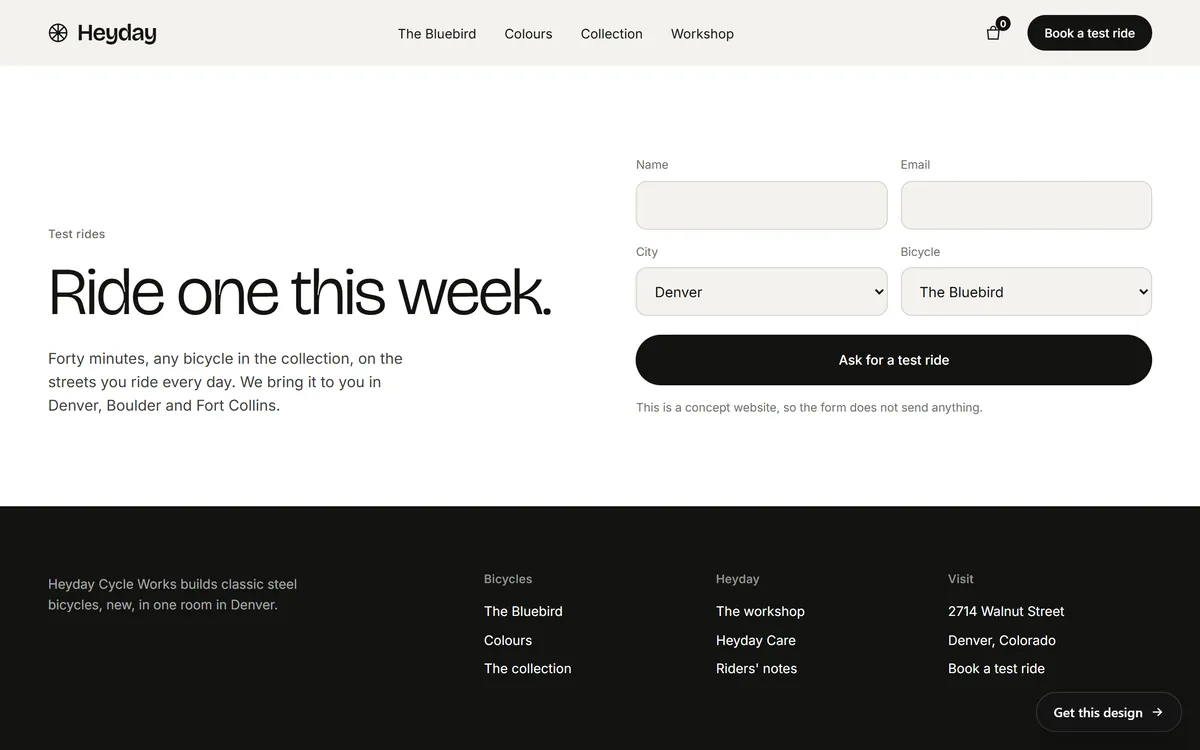
Heyday, a bicycle concept site, shows the better way on its booking form. The heading is "Ride one this week." The line below says: "Forty minutes, any bicycle in the collection, on the streets you ride every day. We bring it to you in Denver, Boulder and Fort Collins." The button reads "Ask for a test ride". Every word tells the visitor what happens, and nothing says "Submit".
Filler words and clichés
Filler makes a sentence longer and weaker. Cut "very", "really", "just", "actually", "basically" and "in order to". Cut clichés, too: "one-stop shop", "second to none", "we pride ourselves on", "think outside the box", "at the end of the day". If a phrase sounds like something you have heard in a hundred ads, it will not stay in anyone's mind.
Words that talk down
"Simply", "just", "easy" and "obviously" can make visitors feel foolish when something is not easy for them. "Simply fill out the form" is fine if the form is simple. If it is not, the word works against you. Describe the step and let the visitor judge: "Fill out the form, which takes about two minutes" is better, if it is true.
Words that hide the next step
"Contact us for more information" is a polite way of saying "we will not tell you here". "Get in touch" and "Reach out" have the same problem. Say what you want the visitor to do and what they get in return: "Call to book a visit", "Send us your address and we will send a written quote". For a button, use a verb and an object. The next step should always be a specific action, never a vague invitation.
Words that leave people out
Slang, idioms and sports talk can confuse readers who learned English as a second language, and some of your customers may be among them. "Hit it out of the park", "ballpark figure" and "touch base" are clear to some readers and mysterious to others. Plain words travel better. The same goes for abbreviations: write the full name once, then the short form. If your site also has a Spanish version, write it on its own, in natural words, and use the same names for your services in both languages so that customers can match them.
What to write instead: specific details
The cure for weak words is detail. Ask "what exactly?" until a sentence has something in it that only your business could say.
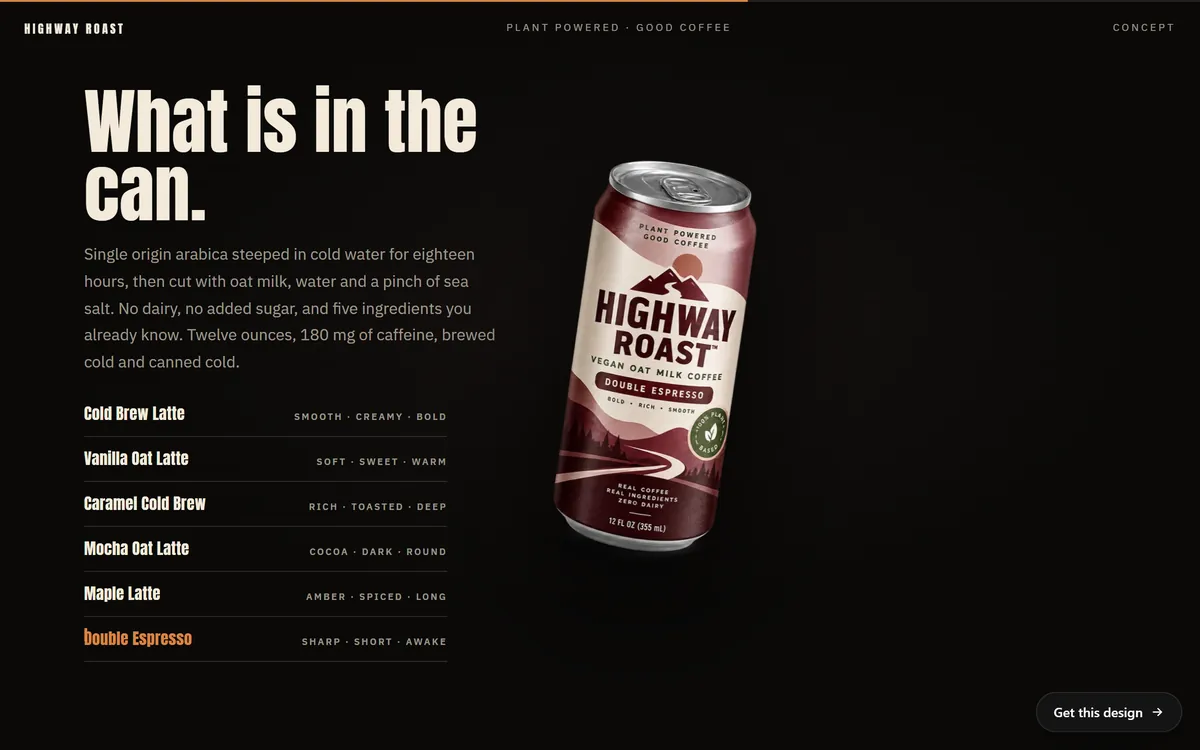
Highway Roast, a coffee concept site, describes its product without a single empty adjective. Under the heading "What is in the can.", it says that the coffee is single origin arabica steeped in cold water for eighteen hours, then cut with oat milk, water and a pinch of sea salt. It adds that there is no dairy and no added sugar, and that the can holds twelve ounces. You do not need to be told it is good. You can picture it.
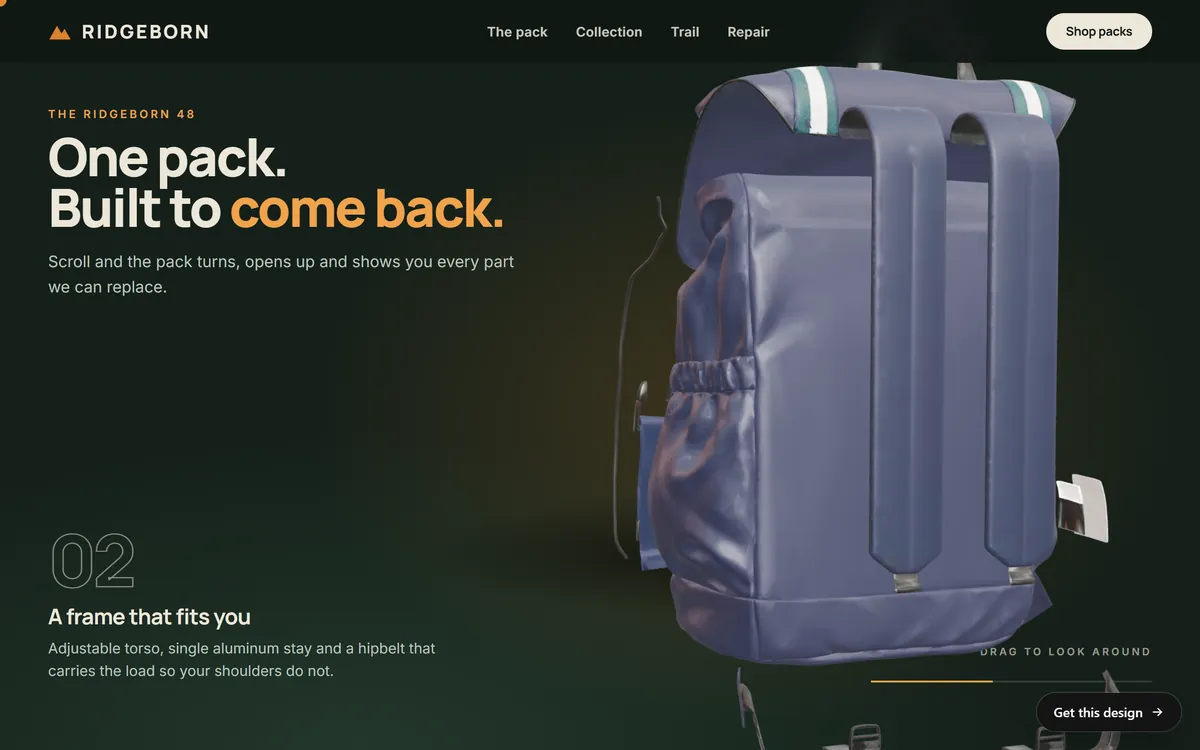
Ridgeborn, an outdoor gear concept site, does the same with benefits. Its pack features come with one plain sentence each. The frame, for example, is "adjustable torso, single aluminum stay and a hipbelt that carries the load so your shoulders do not". The last part turns a feature into a benefit in plain words.
Keep a short list of your own words
Consistency builds trust. Make a short list of the names you will use for each service, each product and each kind of customer, and use them everywhere: in the menu, on the pages, in the buttons and in the emails. If a service is called a "tune-up" in one place and a "maintenance visit" in another, visitors wonder whether they are the same thing. Add to the list the words you have decided not to use, so that anyone who writes for your business, including you in six months, follows the same rules.
A clean-up method in six steps
- Paste your page into a document. Seeing it plain makes weak words easier to spot.
- Highlight every adjective. Next to each, ask whether you can show it.
- Replace each with a fact, or delete it.
- Check every claim. For each one, write down the proof. If you cannot, cut it.
- Search for the words in the list below.
- Ask someone outside your business to read it, and mark every word or phrase they do not understand.
Words to search for before you launch
Use the search function of your document and look for these. Not every one is wrong, but each deserves a second look.
- best, #1, number one, leading, top-rated, the only, guaranteed, 100%
- free, sale, discount, limited time, last chance, going out of business
- innovative, cutting-edge, state-of-the-art, world-class, solutions, synergy
- passionate, dedicated, committed, quality, excellence, premium, unique
- affordable, competitive, fast, friendly, reliable, great service
- eco-friendly, green, sustainable, natural, biodegradable, recyclable, Made in USA
- welcome, click here, learn more, submit, lorem ipsum, TBD
Plain words, written for you
When we write the texts of your site, we start from your answers to a few questions on day 1, and we write with plain, specific words. Claims are your responsibility, so tell us what you can back up: your licenses, your years in business, your awards. We use only those. Each stage has one round of changes, so you can remove any word you are not comfortable with. When you are ready, you can start your site.
Questions people ask
What words should I avoid on my business website?
Avoid empty buzzwords like "innovative" and "solutions", vague promises like "affordable" and "fast", claims you cannot prove like "best" and "number one", and filler like "welcome" and "click here".
Can I say I am the best in my city?
Only if you can prove it. The FTC says every claim, including implied ones, needs objective evidence. Even when you can, a specific fact is more convincing than "best".
Can I use the word "free" in my marketing?
Yes, if it is truly free. The FTC's small business guide says a free offer tied to a purchase should not push the price of the purchase above its regular price, and conditions must be clear.
What can I say instead of "high quality"?
Describe what makes it high quality: the material, the process, the test, the warranty. "Solid maple, finished by hand" says more than "high quality".
Is it okay to say my products are eco-friendly?
Be careful. The FTC has guidance on environmental claims, and states may have their own rules. Describe the specific thing you do, such as what is recycled and how much, and ask a lawyer if you are unsure.
When can I say "Made in USA"?
The FTC says the product must be all or virtually all made in the United States. If that is not true for your product, do not use the phrase.
Why is "click here" a bad link?
It says nothing out of context, and screen readers read links as a list. Write links that say where they lead, such as "See our prices".
Should I write "Welcome to our website"?
No. Visitors know where they are. Use the space to say what you do and who you help.
Are "simple" and "easy" good words to use?
Only when they are true for the visitor. If a step is not easy for them, the word works against you. Describe the step instead, and let them judge.
How do I know if a word is too vague?
Ask what a visitor learns from it. If the answer is "nothing", or if every competitor could say the same, replace it with a fact.
Want a website that does all of this? Start your site