Headlines that make people keep reading
A headline has one job: to make the right person read the next line. Here are the rules, formulas and tests we use, with headlines from our designs.
A headline has one job: to make the right person read the next line. Most visitors read the headline and little else, so it has to be clear first and clever second. This lesson gives you the rules, the formulas and the tests we use, with headlines from our designs.
A headline makes a promise
When someone lands on a page, the headline is the first thing they judge. In a second or two, it should tell them three things.
- Where they are. What kind of business or page this is.
- Whether it is for them. The right person should feel recognized, and the wrong person should be free to leave.
- Why to keep reading. A benefit, a result or a reason to be curious.
The rest of the page has to keep the promise. A headline that sounds exciting and leads to a dull page loses trust faster than a plain headline that delivers.
Be clear first, clever second
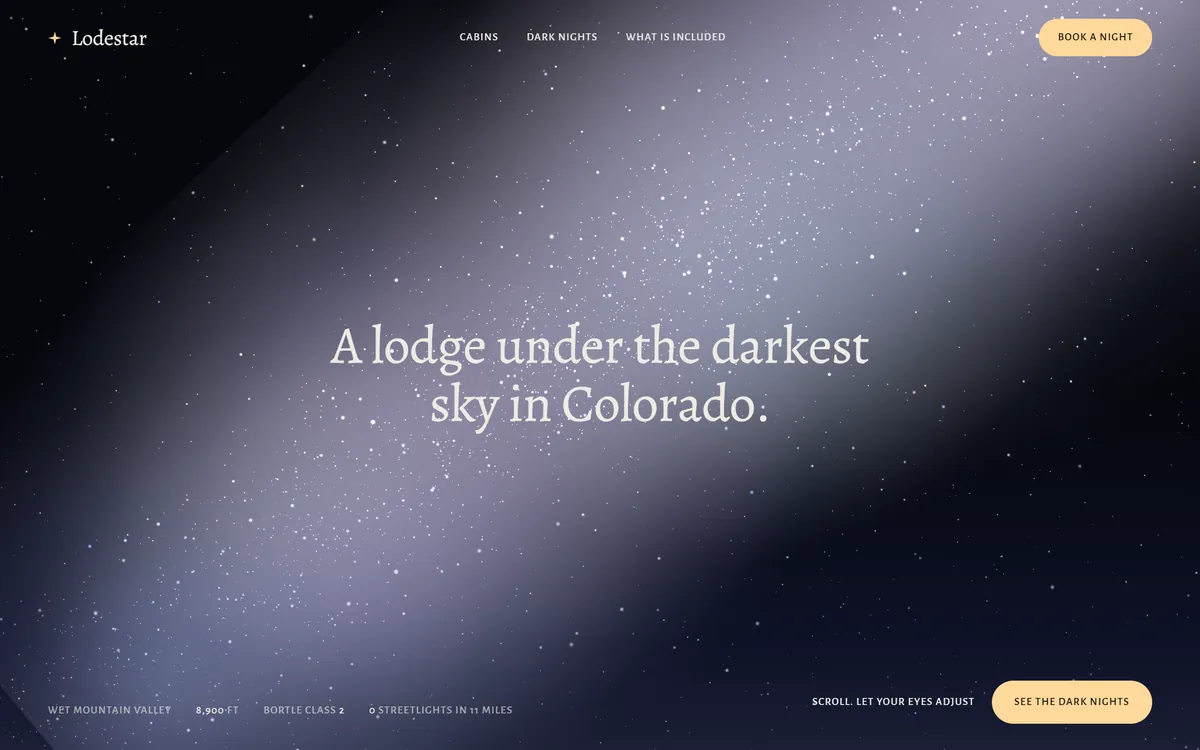
The strongest headlines say a real thing in plain words. Lodestar, a dark sky lodge on one of our concept sites, opens with: "A lodge under the darkest sky in Colorado." It names the thing (a lodge), the place (Colorado) and the reason to care (the darkest sky). A visitor who has never heard of the place understands it at once, and the sentence is still beautiful.
Usability research points the same way. In an early eye-tracking study of news sites, written up by the Nielsen Norman Group, plain headlines beat cute ones. The lesson holds for small businesses: people scan, and they stop at words they understand.
When a headline is poetic, add a plain line
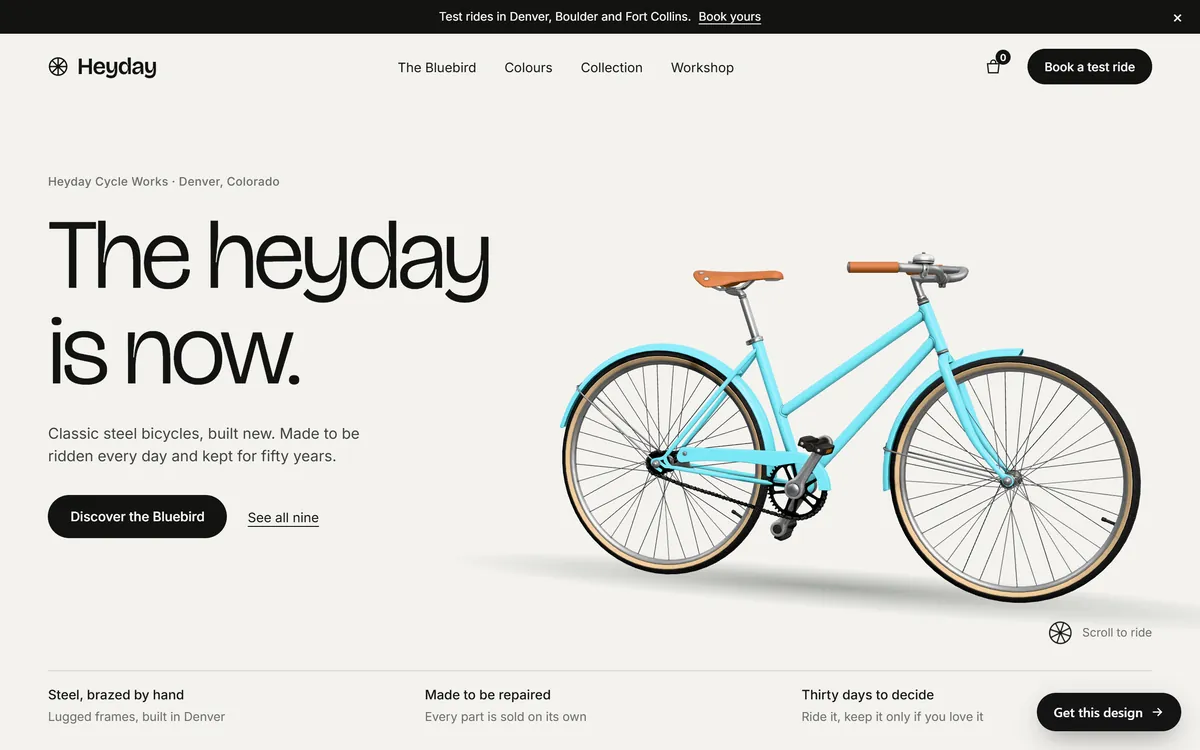
Some businesses want a headline with more mood. That is fine, as long as the line under it says plainly what you do. Heyday, a bicycle concept site, opens with "The heyday is now." That alone does not say what the company makes. The sentence right under it does: "Classic steel bicycles, built new. Made to be ridden every day and kept for fifty years." The headline sets the mood, and the next line gives the facts.
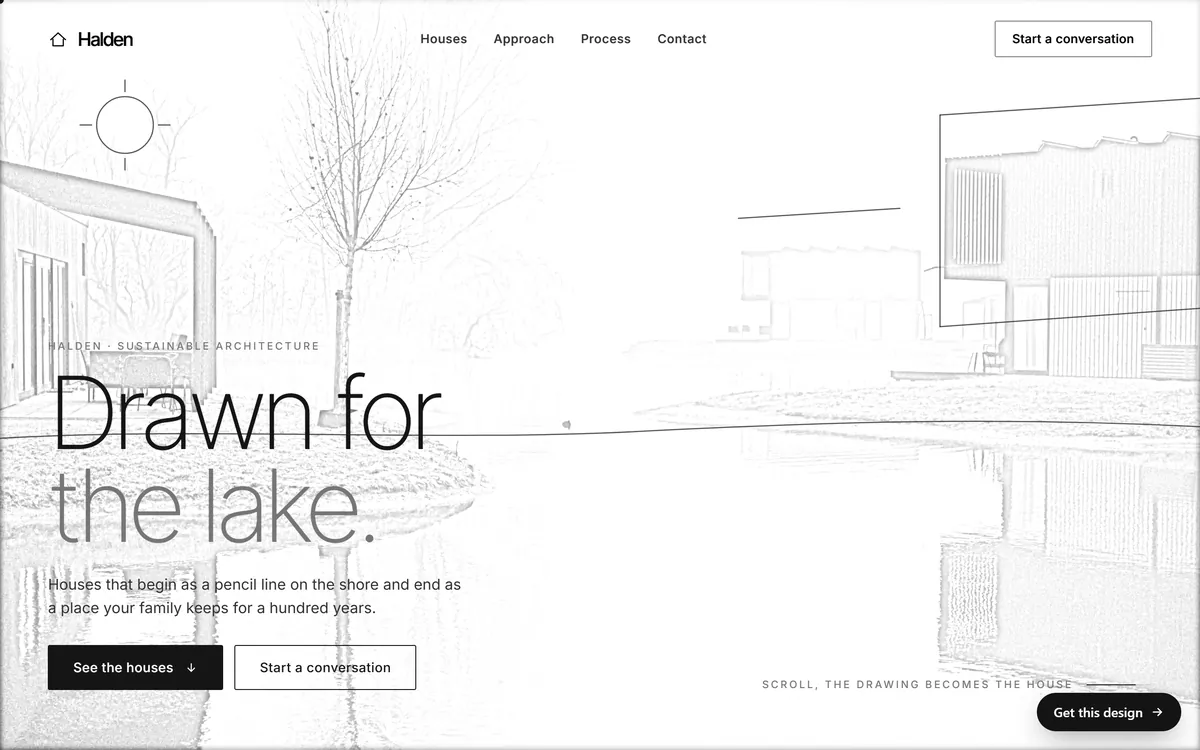
Halden, an architecture concept site, does the same. The headline is "Drawn for the lake." and the line under it says: "Houses that begin as a pencil line on the shore and end as a place your family keeps for a hundred years." You could not guess the business from the headline alone. With the line, you can.
This is the cover test. Cover the line under your headline and read the headline alone. If it still tells a stranger what you do, you are safe. If it does not, the supporting line must sit right under it, on the first screen, in text large enough to read on a phone.
Six headline formulas to start from
When you are staring at a blank page, a formula helps. Here are six, each with an imaginary example.
- What + who + where. "Family dentist in Tampa, open on Saturdays."
- The result they want. "A kitchen you will actually cook in."
- The problem removed. "No more waiting around for the plumber."
- A question they already ask. "Is your roof ready for hail season?"
- A number, if it is true. "Five questions to ask before you hire a mover."
- A contrast. "Less time on invoices. More time with your clients."
The first formula is the safest for a home page or a service page. The others work well for sections, blog posts and special offers. Try several for the same page and compare. The best one is often the plainest.
Fix five weak headlines: made-up examples
Here are five weak headlines for imaginary businesses, each with a stronger version and the reason it works.
- Weak: "Welcome to Green Leaf Landscaping." Stronger: "Lawns and gardens for Austin homes, planted and kept all year." It says what, for whom and where.
- Weak: "Quality you can trust." Stronger: "Brakes checked, explained and fixed the same day." It replaces a claim with something the customer can see happen.
- Weak: "Solutions for your financial future." Stronger: "Tax help for freelancers who hate paperwork." It names the person and the problem.
- Weak: "Where passion meets flavor." Stronger: "Wood-fired pizza on Main Street." It gives a food and a place, and it can be checked.
- Weak: "We are different." Stronger: "One crew, from the first visit to the last coat of paint." It shows how the business is different instead of saying it.
The stronger versions are a few words longer, and they are much easier to understand. Short is good, but clear is better.
Section headings should say something too
Small headings do as much work as the big one, because visitors scan them to decide what to read. A heading that says "Our services" or "Why choose us" tells a scanner nothing. A heading that makes a point gives them something to take away.
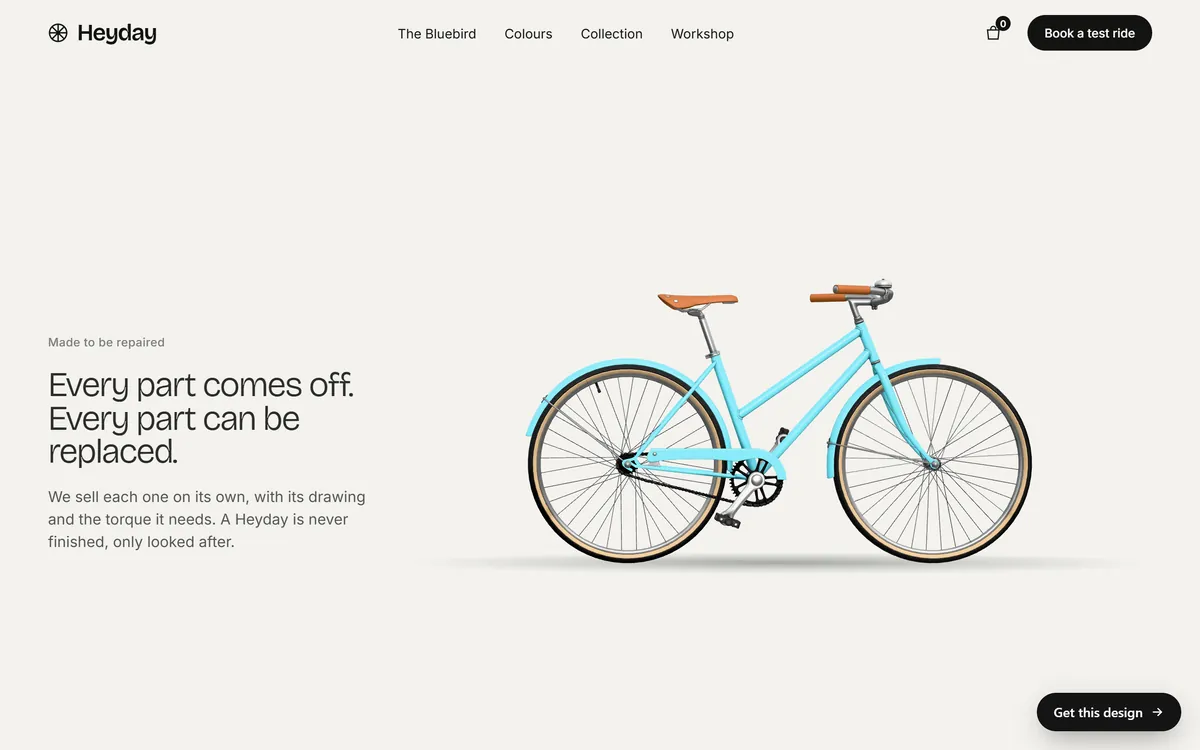
On the Heyday page, the section about repairs is headed "Every part comes off. Every part can be replaced." It is a promise, it is concrete and it is short. The sentence below it explains: the company sells each part on its own, with its drawing and the torque it needs. A visitor who reads only that heading already knows what makes the brand different.
Keep plain labels for places where people look for things by name: the menu, the footer and buttons like "Contact". Everywhere else, write headings that say something. The lesson on writing for people who skim shows how this pays off.
A headline for each kind of page
Each page has its own job, so each needs its own kind of headline.
- Home page: what you do, for whom and where.
- Service page: the name of the service, the place and, if you can, the result.
- About page: something human, such as who you help and why you started.
- Offer or landing page: the offer itself and what the visitor gets.
- Contact page: what happens next, such as "Tell us about your project and we will write back."
- Blog post: the question the post answers, in the words people use to ask it.
Read it on a phone
On a phone, a headline fills much more of the screen than on a computer. A long one can push everything else out of sight. Look at your headline on your own phone before you approve it. If it runs past four lines, shorten it. Check where the lines break, too: a single word alone on the last line looks careless and is easy to fix.
Write ten, then choose one
Nobody writes the best headline first. Use this routine.
- Set a timer for ten minutes and write ten headlines for the page. Do not judge them yet.
- Circle the three clearest. Cross out any that need an explanation.
- Read them out loud. You will hear which ones sound like a person talking.
- Run the tests below on the finalists.
- Choose one and keep a second as a backup for the main supporting line.
Four tests for any headline
- The cover test. Read the headline without the line under it. Does it still make sense?
- The five-second test. Show the page to someone for five seconds, then ask what the business does.
- The "so what?" test. After you read the headline, ask "so what?" If the answer is not in the headline or the line under it, rewrite.
- The swap test. Put a competitor's name where yours is. If the headline still works, it is too generic.
Words that earn their place
Headlines are short, so every word counts. Prefer:
- Specific nouns: "water heater", not "solutions".
- Strong verbs: fix, build, bake, deliver, repair.
- Numbers you can back up.
- Place names, when the place matters to the customer.
- "You" and "your", which speak to the reader.
Cut these: "Welcome to", "solutions", "innovative", "ultimate", exclamation marks, all capital letters and puns that hide the meaning. A pun is fine only when the plain meaning is still clear to someone who misses the joke.
Headlines and Google
Your page has two headlines that people see. The first is the large heading on the page itself, called the H1. The second is the page title, which shows in the browser tab and as the clickable line in Google results. They have different jobs. The H1 welcomes a visitor who is already on the page, and the title convinces a searcher to click. They should say the same thing in different words.
- Use one H1 per page.
- Put the words people really search for in both, naturally, without stuffing.
- Keep titles short, so they are not cut off. Around 60 characters is a common guide.
- Know that Google sometimes shows a different title than the one you wrote.
A later series in Start From Zero covers titles and descriptions in detail.
Keep the promises your headlines make
A headline that promises too much is a bad headline, even if it gets a click. Visitors who feel tricked leave and do not return. There is also a legal side. The Federal Trade Commission's guide for small businesses says every claim in an ad, including one that is only implied, needs objective evidence behind it, and that evidence must exist before the ad goes live. So if your headline says "the fastest" or "number one", you need to be able to show it. If you cannot, write something you can prove.
Headlines in two languages
If your site has an English version and a Spanish version, write each headline for its own audience. A word-for-word translation often sounds strange, and it can run much longer, which breaks the layout on a phone. Keep the meaning and the promise the same, and let the wording be natural in each language. Then check that both versions fit on a small screen.
Headline mistakes to avoid
- "Welcome." It says nothing about what you do.
- A slogan that fits any business. "Excellence in everything we do" could be anyone's.
- Cleverness that hides the meaning. If people have to decode it, most will not.
- Too long. A headline that wraps over four lines on a phone is hard to take in.
- All capital letters. They are slower to read and feel like shouting.
- Promises you cannot keep. Claims need proof, and the page must deliver what the headline offers.
- The same headline on every page. Each page has its own job, so each deserves its own headline.
Headlines and Good Sites Only
When we build a site, we write the headline of every page for you, from the answers you give us on day 1. You see them on your mockup on days 3 and 4, and each stage has one round of changes, so you can ask for a plainer line or a different promise. It helps to tell us the words your customers use when they describe what you do, because the best headlines borrow those words. When you are ready, you can start your site.
Questions people ask
What makes a good headline?
It is clear, specific and honest. It tells the right person what the page offers and why to keep reading, and the page delivers on it.
How long should a headline be?
Short enough to say in one breath, and short enough that it does not fill a whole phone screen. If you cannot read it aloud easily, cut a few words.
What is the difference between a headline and a page title?
The headline is the large heading on the page. The title is what shows in the browser tab and in Google results. They should say the same thing in different words.
Should a headline be a question?
Sometimes. A question works when it is one your customers already ask. Avoid vague questions, and make sure the page answers the one you ask.
Should I use numbers in a headline?
Yes, when they are true and useful. "Five questions to ask before you hire a mover" is clear. Do not invent numbers or round them up to sound better.
Can I use humor in a headline?
A little, if it fits your brand and the meaning is still clear. Never let a joke replace the information.
How many headlines should a page have?
One main headline, called the H1, and several smaller headings below it to break the page into sections. Each small heading should say something useful.
Should I capitalize every word?
There is no rule. Sentence case, where only the first word and names are capitalized, is easier to read. Choose one style and use it everywhere.
How do I write headlines for Google?
Use the words your customers type, naturally, and put what the page is about first. Do not stuff in keywords, because that makes the headline harder for people to read.
How do I know which headline works best?
Show two or three versions to people who do not know your business and ask what each one tells them. The one that people understand fastest is usually the winner.
Want a website that does all of this? Start your site