How to write your About page
Your About page is where visitors decide whether to trust you. Here is how to write it in clear parts, with examples from our designs.
Your About page is where a visitor decides whether to trust you. It is not a biography, and it is not a mission statement. It shows that real people stand behind the work, what they care about and how they treat customers. This lesson shows how to write one in clear parts, with examples from our designs.
What visitors look for on an About page
People open an About page at a moment of doubt: before they call, before they pay, before they send you their address. They are not looking for a long story. They want four answers.
- Who is behind this business? A name, a face, a team.
- Are they real, nearby and easy to reach? A place, a phone number, a way to talk to someone.
- Do they know what they are doing? Experience, training, a way of working.
- What will it be like to work with them? The tone, the steps, what happens next.
Google's guidance on writing helpful content points to a site's About page as one place where readers can find background on who is behind the content. It also calls invented authors, such as made-up names, fake headshots or fake qualifications, a form of deception. The same advice works for any business: show who you really are, and visitors will treat you as real.
Open with what you do for customers
Begin with a sentence about the customer, not about the year you were founded. "We help busy families in Tampa keep their teeth healthy" gives a visitor something to hold on to. Start in 1998 and you lose them before you get to the point.
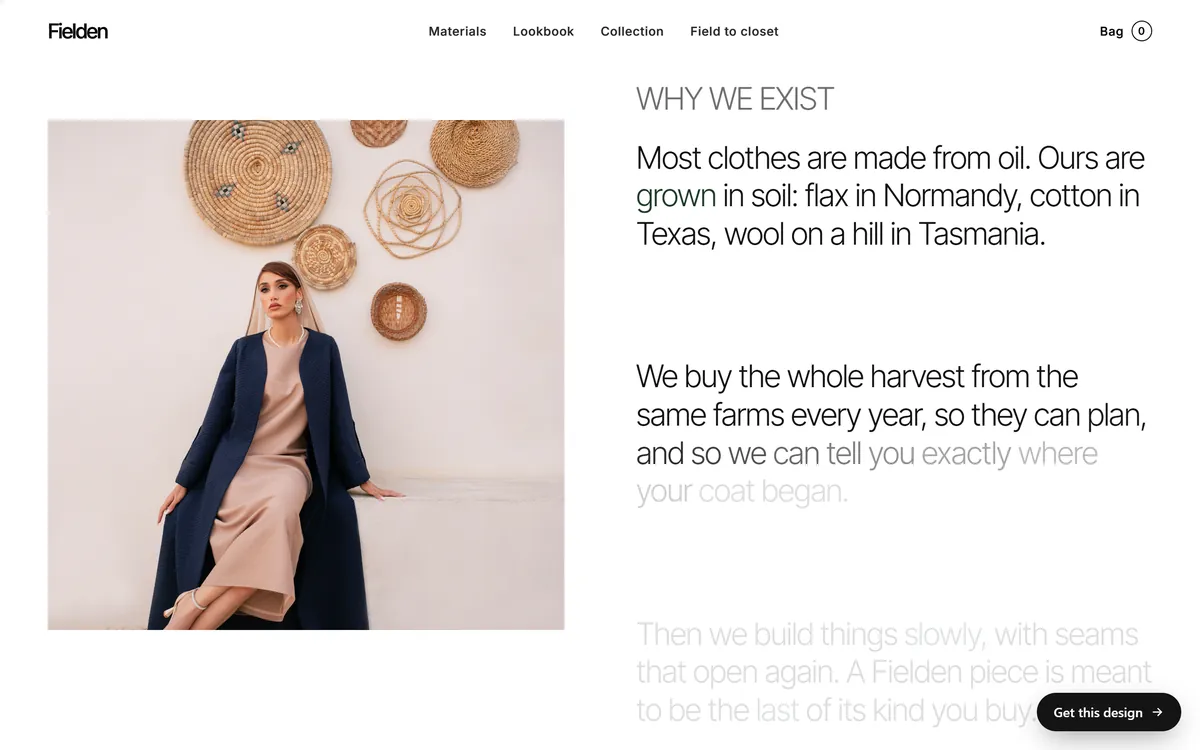
Fielden, a clothing concept site, shows another way to open. Its "Why we exist" text starts with a position and then names places: "Most clothes are made from oil. Ours are grown in soil: flax in Normandy, cotton in Texas, wool on a hill in Tasmania." The first sentence tells you what the brand believes, and the second proves it with names you could look up. The next lines say the brand buys the harvest from the same farms every year, and that its clothes are meant to be the last of their kind you buy.
Tell your story in four short paragraphs
Your story earns trust when it is short and true. Four paragraphs are enough for most small businesses.
- The problem you saw. What was wrong with how things were done?
- Why you started. What you did before, or the moment that made you decide.
- What you do differently. One or two things a customer can notice.
- Where you are now. Who you serve, where, and what you are working toward.
Here is an example for an imaginary family bakery, only to show the tone: "I started baking at four in the morning because the bread on our street came off a truck. Nine years later we still bake before sunrise in the same small shop, and we still know most of our customers by name." It is plain, it has a detail you can picture and it makes no big claims.
Write in the first person singular ("I") if you work alone, and in "we" if you are a team. Pick one and stay with it. If you were a nurse, a teacher or an electrician before you started your business, say it. The past that explains why you are good at the work is worth a sentence.
Show how you work, not only what you believe
Words like integrity, quality and passion fill thousands of About pages, and they prove nothing. A way of working is more convincing, because a customer can imagine it happening. Replace each value with a habit.
- Instead of "We value communication", write "We call you before we arrive and send a written summary the same day."
- Instead of "We care about the environment", write what you do: what you recycle, what you reuse, what you refuse to throw away.
- Instead of "We are committed to quality", describe one check you always do before you hand over the work.
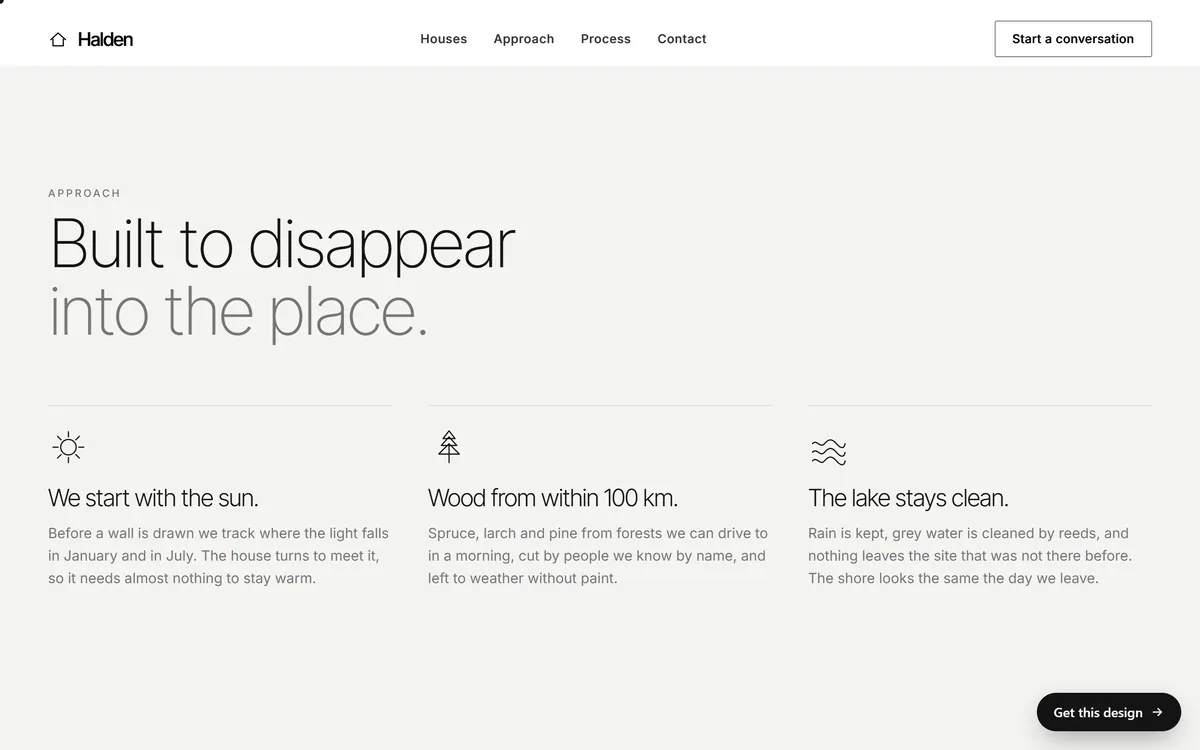
Halden, an architecture concept site, writes its approach this way. Three short statements, each followed by a sentence of proof: "We start with the sun", "Wood from within 100 km" and "The lake stays clean". Each one is easy to remember, and each one says something a client could verify. Notice the pattern, because you can copy it: a short claim in plain words, then the detail that backs it up.
Put names and faces on the page
A page about people needs people on it. Use real photos, real names and one line about what each person does. If you work alone, a photo of you at work is better than a logo. A photo taken with a phone in good light is fine, and it usually feels warmer than a studio portrait.
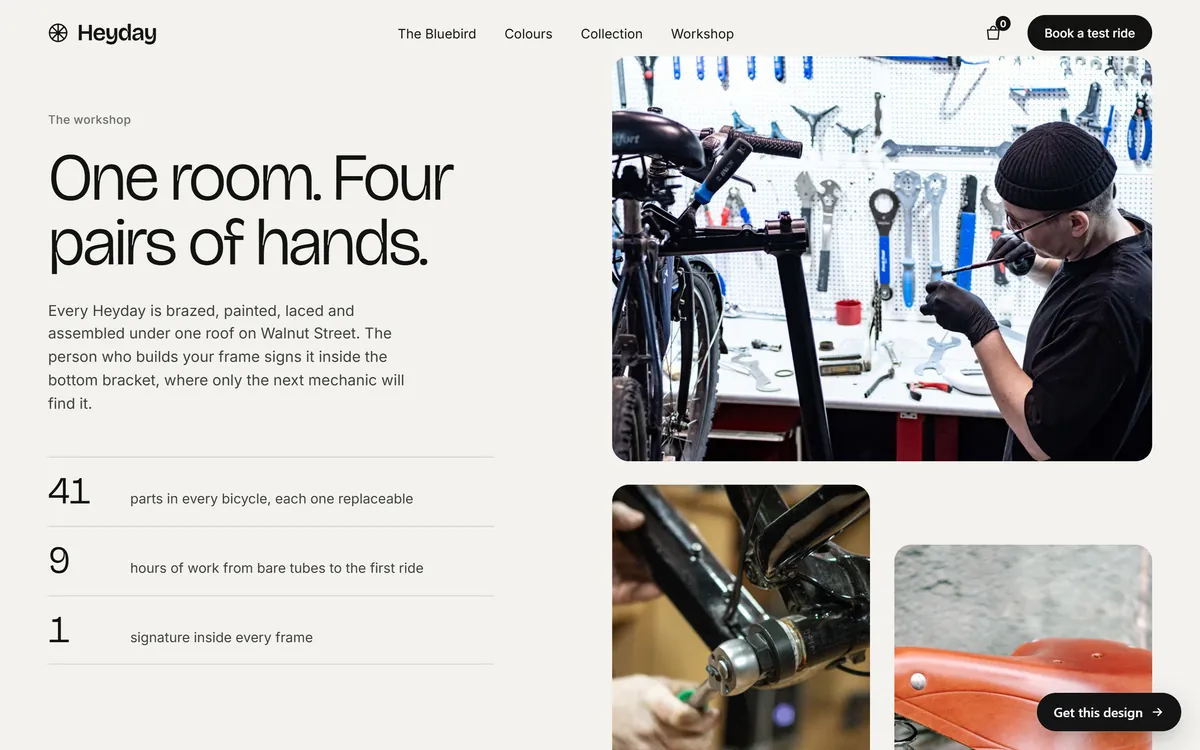
Heyday, a bicycle concept site, gives its workshop its own block: "One room. Four pairs of hands." The paragraph explains that every bicycle is brazed, painted, laced and assembled under one roof, and that the person who builds your frame signs it inside the bottom bracket. A photo of someone at work in the workshop sits next to it, with three small facts underneath. You learn who makes the product, where and how, in about ten seconds.
Do not use stock photos of people who do not work for you. Visitors can tell, and it takes away the very trust the page is meant to build. Ask your team before you publish their photos and names, and keep the page current when someone leaves.
Name the people and places you work with
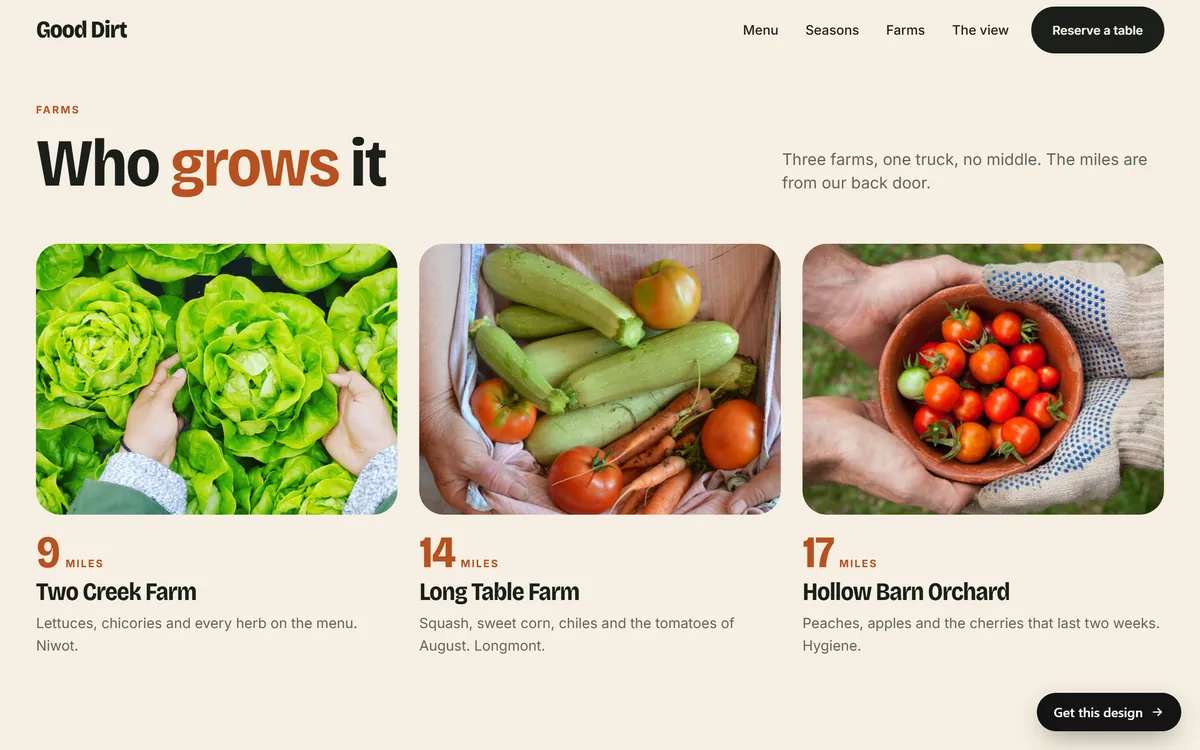
Names make a business feel part of a community. If you buy from local suppliers, work with partner companies or support a cause, say so, with their permission. Good Dirt, a restaurant concept site, does it with three farms. Each farm gets a name, a distance from the restaurant's back door, what it grows and the town it sits in. The section is only a few lines long, and it tells you more about the restaurant than a paragraph of adjectives would.
For a service business, the same idea works with places. List the towns and neighborhoods you serve, the local groups you belong to and the schools or charities you support.
Add facts a stranger can check
Facts calm doubts better than adjectives do. Choose the ones that apply to you.
- The year you started, and how many years you have worked in your field.
- Your license and insurance, with numbers where your trade or state asks for them.
- Certifications and memberships, written exactly as the organization writes them.
- Awards, with the name of the award and the year.
- The size of your team, your address and your hours.
Keep a simple proof file. For each claim on the page, note where the proof lives: a certificate, a license, an invoice, a letter. If you cannot show it, do not write it. And never round up. Eight years is eight years.
Write the way you talk
An About page should sound like you on a good day. Use contractions, short sentences and the words you use with customers. Read the page out loud. If you would not say a sentence to a customer, change it.
Warmth is welcome, and a little humor is fine when it comes naturally. Avoid the words that appear on every About page: passionate, dedicated, committed, world-class, cutting-edge. A later lesson in this series lists the words to avoid and what to write instead. If your site is in English and Spanish, write each version on its own, in natural words, and check that the facts match in both.
Say what it is like to work with you
Many visitors worry less about your skills than about the experience. Will you answer? Will you show up? Will there be surprises? Give them a short picture of how a project goes: the first call, what you need from them, the main steps, how you keep them informed. Three or four lines are enough. Only promise what you can keep. If you say you answer the same day, you must answer the same day.
It also helps to say who you are not for. "We do not take rush jobs" or "We work with homeowners, not with developers" will lose you a few visitors and keep you from many bad matches.
End with a next step
A visitor who finishes your About page is warm. Do not leave them at a dead end. Close with one sentence and one button: call, write, book a visit, see the work. Repeat your phone number and your city near the button.
A fill-in outline for your About page
- One sentence about who you help and what you do.
- Your story in three or four short paragraphs.
- How you work: three habits, each with a sentence of proof.
- The people: real photos, names and roles.
- Facts: years, licenses, memberships and the places you serve.
- Partners and places you work with, named with permission.
- A closing line and a button.
You can write all seven parts in an afternoon. Do not worry about length. A one-person business can say everything in a few short paragraphs and a photo. A larger team may need more sections. Use headings and photos so people can scan the page, and let the content decide the length.
About page mistakes to avoid
- "Founded in 1998 with a passion for excellence." It sounds like every other company.
- All about you. The visitor is the hero. Connect each fact to something they gain.
- Vague values. If you cannot show a value in action, cut it.
- No names or faces. A page without people feels like a form letter.
- Stock photos. Use real people, even if the photo is simple.
- A history lesson. Keep the story to what helps a customer trust you today.
- Claims with no proof. Awards without names and numbers without a source raise suspicion.
- Old information. A team photo with people who left makes the whole site look neglected.
- No next step. Always end with a way to get in touch.
Your About page and Good Sites Only
We write your About page for you. You answer a few questions from your phone on day 1, and your texts are written on days 1 and 2 from your answers. That is why the facts matter: tell us what is true and what you can back up, and we use only that. Each stage has one round of changes, so you can check every fact and fix any sentence that does not sound like you. You bring real photos of your people and your place, and we put them where they work best. To see how different businesses tell their story, look at our designs.
Questions people ask
What should I put on my About page?
A sentence about who you help, your story in a few short paragraphs, how you work, photos and names of the people, facts a stranger can check and a way to get in touch.
How long should an About page be?
Long enough to answer the visitor's doubts, and no longer. A one-person business can do it in a few short paragraphs. Use headings and photos so the page is easy to scan.
Should I write "I" or "we" on my About page?
Use "I" if you work alone and "we" if you have a team. Choose one and keep it the same through the whole page.
Do I need a photo of myself on the website?
It helps a lot. People trust a face more than a logo. A clear photo of you at work, taken in good light, is enough.
What if my business is new and I have no story yet?
Tell the story you do have: what you did before, why you started and how you will work. Do not invent customers, years or awards. Honest and clear is more convincing than impressive and made up.
Should I mention my personal life?
A little, if it helps a customer trust you or understand why you do this work. Keep private details, like your home address or your children's names, out of the page.
Does the About page matter for Google?
It is not a trick for rankings. It matters because Google's guidance on helpful content points to the About page as a place to show who is behind the site, and because visitors use it to decide whether to trust you.
Should my About page include a mission statement?
Only if it is short and specific. A mission that could belong to any company does not help. Show your values through the way you work.
Can I use stock photos on my About page?
Avoid them for the people in your business. Use real photos of your team and your place. Stock photos of "a smiling team" make visitors wonder what else is not real.
How often should I update my About page?
Whenever a fact changes: a new license, a new team member, a new location. Read it once a year and fix anything that is no longer true.
Want a website that does all of this? Start your site