Reviews and testimonials on your website
Customers believe other customers. Here is how to collect and show reviews and testimonials, and what the FTC says about fake ones. Not legal advice.
People believe other customers more than they believe you. Reviews and testimonials let your customers do the talking, but only when they are real, specific and shown honestly. In the United States, fake reviews are also a legal problem. This lesson covers both: how to collect and show good ones, and what the Federal Trade Commission says in plain words.
Reviews, testimonials and case studies are different things
People use these words as if they meant the same thing, but each one does a different job.
- A review lives on a platform you do not control, such as Google or Facebook. The customer writes it there, in their own words.
- A testimonial is a quote from a customer that you show on your own site, usually with their name and place.
- A case study is a short story about one job: the problem, what you did and what changed.
A good site uses all three. Reviews give independent proof, testimonials put the best proof where visitors are looking, and a case study shows how you work.
What a strong testimonial looks like
A strong testimonial is short, specific and signed. It names a problem and what changed. It sounds like a person, not like an ad. Compare two imaginary examples.
- Weak: "Great service! Highly recommend!" It could be about anything, and it proves nothing.
- Strong: "Our basement flooded in March and they were at the door in two hours. The carpet was dry by Friday." Priya M., Mesa. It names the problem, the speed and the result.
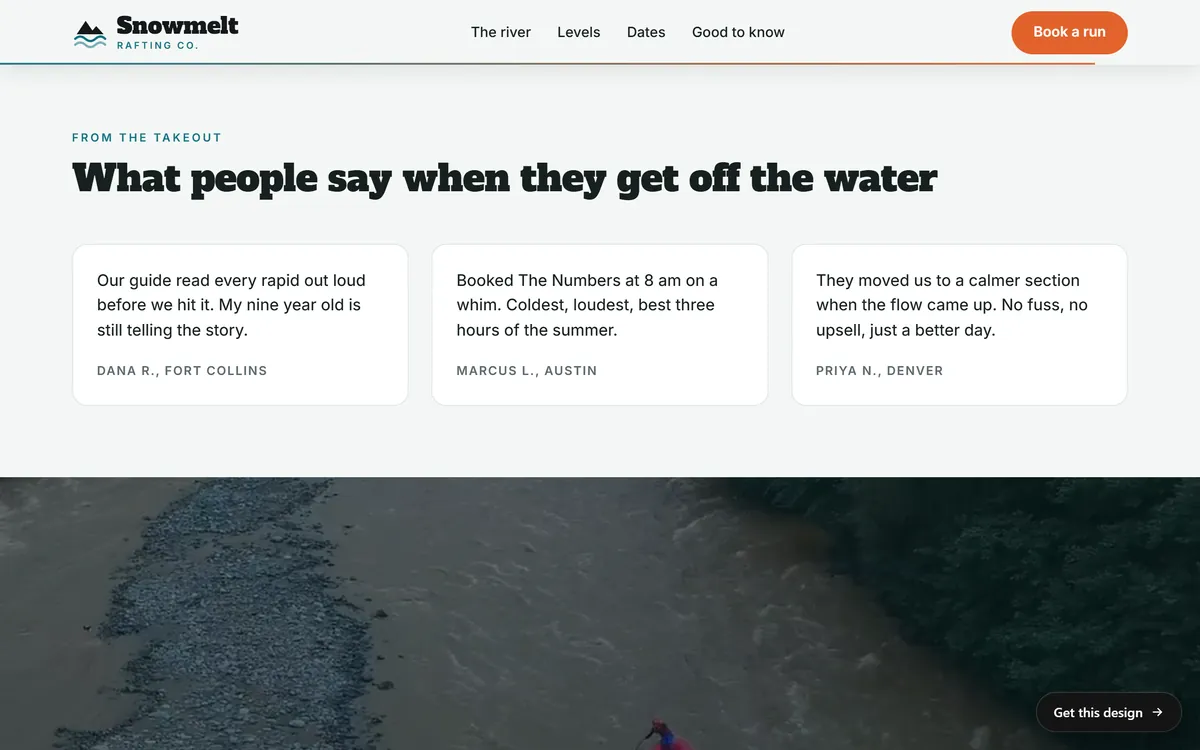
Snowmelt Rafting Co., a concept site, shows three quotes in a row, each one with a first name, a last initial and a city. One says the guide read every rapid out loud before the boat reached it. Another says the company moved a group to a calmer section when the river came up, with no fuss and no upsell. Each quote is a small story with a detail you can picture.
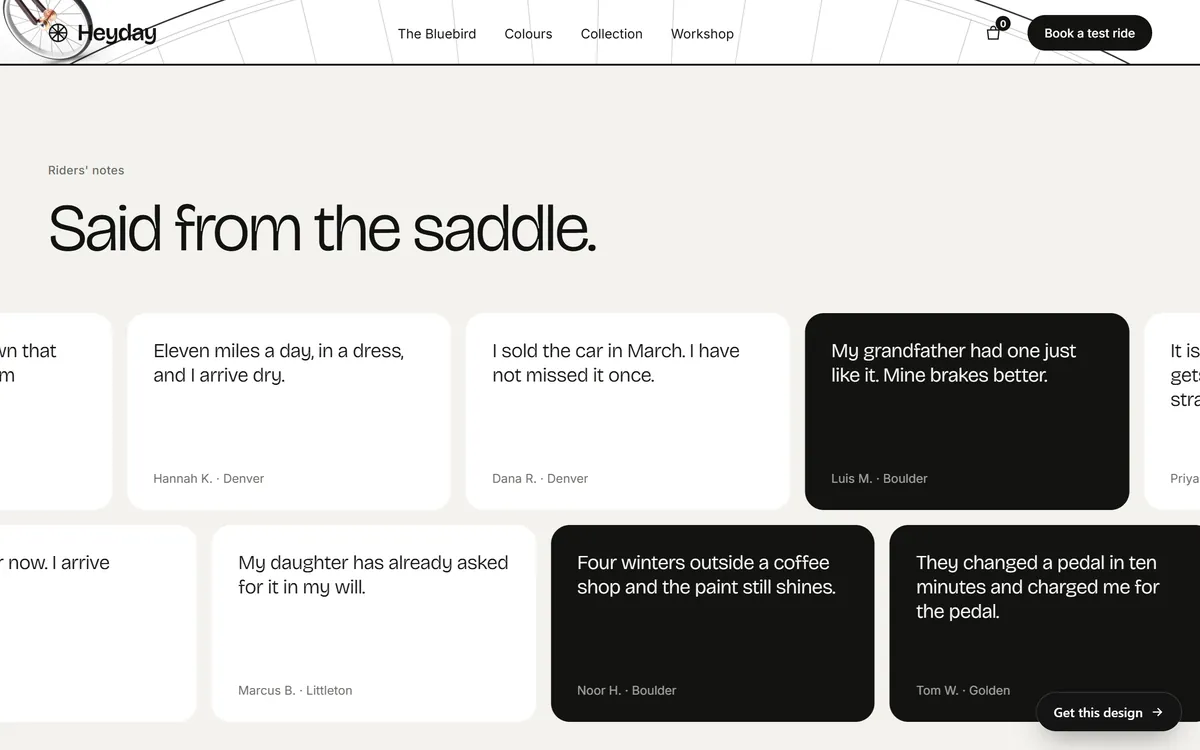
Heyday, a bicycle concept site, goes for volume instead: a wall of very short notes under the heading "Said from the saddle." Each one has a name and a town. The notes are one or two lines long, and many mention one small, believable detail, such as riding eleven miles a day in a dress and arriving dry.
How to ask for a testimonial
Most happy customers never think to write a review unless you ask. A few habits make asking work.
- Ask soon after the job, while the customer still feels the result.
- Ask two simple questions. What was the problem before you called us? What is different now?
- Make it easy. A reply to an email or a text is enough. Do not send anyone to fill in a long form.
- Ask for permission to publish. Say where the quote will appear, and ask if you may use their first name and town, or their photo. A written reply is a good record.
- Say thanks, whatever they answer.
Ask every customer, not only the ones you think will be delighted. And never tell anyone what to say.
How to format a testimonial
Keep the layout plain. Put the quote first, in the customer's words, then their first name, last initial and town or business. If you have permission, add a photo. Leave out stars unless they come from a real rating. Do not change the meaning of what the customer said. If you shorten a quote, keep what matters, and when you are in doubt, send the final version to the customer for approval.
Where to place testimonials
- On the home page: the two or three strongest, near the top half of the page.
- On service pages: the ones about that service, close to the button.
- Next to a form or a button: a short quote right above a contact form is hard to ignore.
- On a page of their own: only if you have enough to fill it.
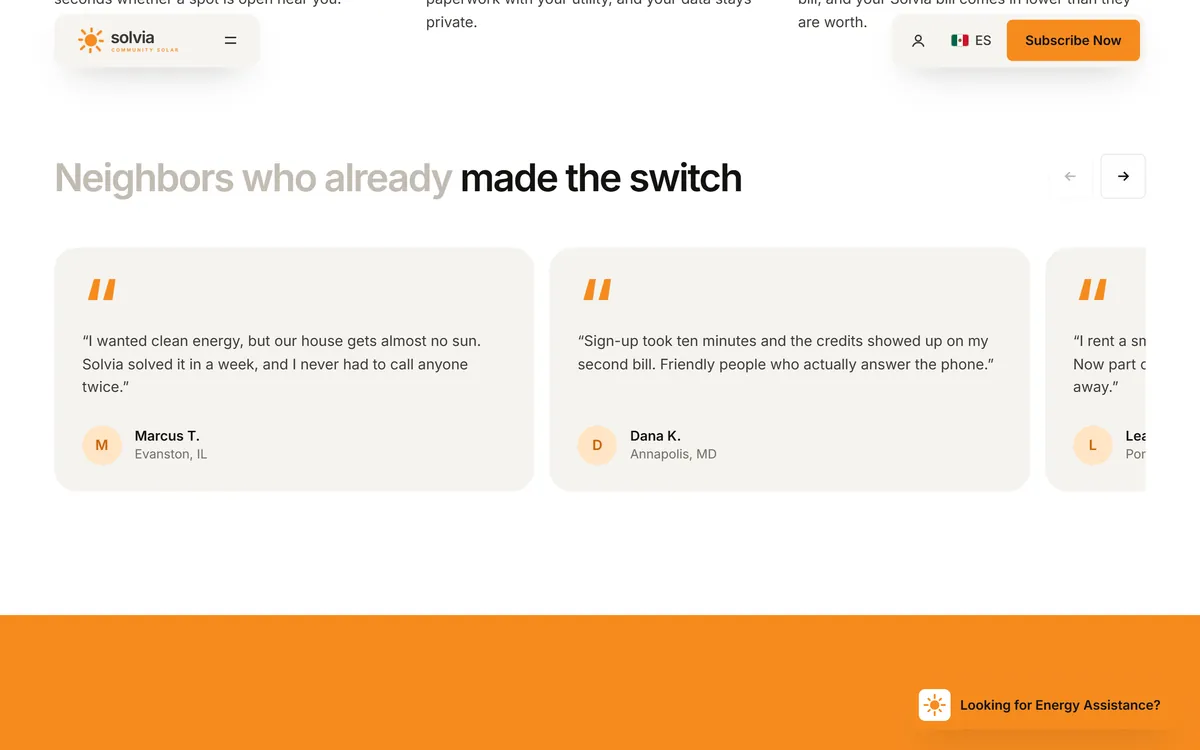
Be careful with carousels. Solvia, a community solar concept site, shows its quotes in cards that slide sideways, with arrows to move them. Cards you can control are fine. A carousel that rotates by itself hides most of the quotes most of the time. Visitors cannot read what moves away.
Show your Google reviews too
If you have a Google Business Profile with reviews, show a few of them on your site and say where they come from. Do not rewrite them, and do not show only the five-star ones if that gives a false picture of how customers feel. A later series in Start From Zero covers how to get more Google reviews. Platforms also have their own rules, so read them before you copy reviews to your own site.
The FTC rule on fake reviews, in plain words
In the United States, fake reviews are not only bad manners. They are a legal risk. This section is a plain-words summary of what the Federal Trade Commission, the FTC, says. It is not legal advice. The FTC itself says its guidance is not definitive or comprehensive, so questions about your own business go to a lawyer.
What the rule is
The FTC's Consumer Reviews and Testimonials Rule is part of the federal regulations (16 CFR Part 465), and it took effect on October 21, 2024. It targets fake and false reviews and testimonials. Courts can impose civil penalties for knowing violations. The FTC's own question-and-answer page does not describe any exception for small businesses.
What you cannot do
- Write, create or sell fake reviews or testimonials. This includes a review by someone who does not exist, or by someone who misstates their experience. A business can be responsible if it knew or should have known that a testimonial misstated the person's use or experience.
- Pay for a particular opinion. Compensation or incentives that depend on a review expressing a positive or negative sentiment are banned. So is implying that a review has to be positive to earn a reward.
- Hide who wrote it. Reviews and testimonials from company insiders, such as officers, employees and their relatives, need a clear and conspicuous disclosure of the relationship. The FTC says a disclosure that needs a click or a hover is not enough. Its answers also say that a relative may post if the relationship is clearly and conspicuously disclosed.
- Pretend to be independent. You cannot present a review site or organization that you control as if it offered independent reviews or opinions.
- Threaten reviewers. You cannot use unfounded legal threats, intimidation, physical threats or knowingly false public accusations to stop a review or get it removed.
- Misrepresent your review section. You cannot say that the reviews on your site represent all or most of the reviews customers submitted if you have hidden the negative ones. Sorting or ordering reviews is not suppression.
- Buy fake social proof. The rule covers fake followers and similar indicators, for example those generated by bots, when you knew or should have known they were fake.
What you can do
- Ask your customers for reviews. Incentives are not banned by this rule, as long as nothing requires or implies that the review has to be positive. Undisclosed incentives can still raise other FTC concerns, and platforms have their own rules.
- Contact a customer who posted a negative review to fix the problem. You can also ask a satisfied customer to update a review.
- Reply to reviews in public. Stick to facts and avoid false accusations, threats and intimidation.
- Show reviews on your own site. The FTC says that simply hosting reviews does not create liability if you neither wrote them nor bought them.
Where marketing changes the rules
The FTC says that when you feature reviews in your advertising, they become testimonials, and the hosting exception no longer applies. It also warns that showing non-representative reviews in your marketing may be deceptive under the FTC Act. The FTC's guide for small businesses adds that an endorsement must honestly reflect what the customer really experienced, that it should reflect typical results, and that a line like "your results may vary" is not enough. Any connection with the person, such as employment, family ties or payment, must be disclosed. And paying to have truthful negative reviews changed or removed may violate the FTC Act.
The practical rule is simple. Show real reviews from real customers, choose a fair mix and never let anyone write one for you.
Turn one good job into a short case study
When a customer has a story with a clear before and after, a short case study can work harder than a quote. Keep it to five lines: who the customer is (a first name and a town, with permission), the problem, what you did, what changed and one photo of the result. Ask the customer to read it before you publish it. Use only facts you can back up, and do not stretch the result. If a job saved a customer a few hours, say a few hours.
What to do with a negative review
Every business gets one sooner or later. How you respond matters more than the review itself. Reply calmly and in public. Thank the person, say what you will do and offer to fix it by phone. Do not argue, and do not accuse. Then fix the problem, because that is what future customers will judge. If the person is satisfied afterward, you may ask whether they would update the review. Do not pay for a change and do not threaten anyone.
If you have no reviews yet, start here
A new business can still build proof. Ask your first customers while the work is fresh. Show real photos of your own work, certifications and licenses, and facts you can verify. Do not ask family and friends to post reviews unless they disclose the relationship clearly, and do not invent anything. A few real, specific testimonials beat a long list of vague ones.
Reviews and Good Sites Only
When we build a site, we can place customer words where they help most, and each stage has one round of changes, so you can decide which quotes go where. We write the other texts of your site from your answers, but testimonials must come from your real customers. Whoever writes your site, the quotes have to come from you, with each customer's permission. If you want help asking for reviews, review requests can be added as a monthly service. You can see how different designs show customer words in our designs.
Questions people ask
Are testimonials on a website legal?
Yes, when they are real and honest. A testimonial has to reflect what the customer actually experienced, and you must not write or buy fake ones. For questions about your own situation, talk to a lawyer.
Do I need permission to use a customer's name or photo?
Ask for it, and keep the reply as a record. Laws about using a person's name or image vary by state, so ask a lawyer if you are not sure.
Can I edit a testimonial?
Fix a typo or shorten it only if the meaning stays the same. When in doubt, send the final version to the customer for approval. A testimonial must honestly reflect what the customer experienced.
Is it illegal to buy reviews?
Writing, creating or selling fake reviews is banned under the FTC's rule. So is giving a reward that depends on a positive review. Buying fake reviews puts your business at real risk.
Can I offer a discount for leaving a review?
The FTC's rule allows incentives only when nothing requires or implies that the review be positive. Undisclosed incentives can still raise other concerns, and platforms like Google have their own rules. Many businesses simply ask, and say thank you.
Can I delete a negative review?
On a platform like Google, the review is not yours to delete. You can reply, and you can ask the platform to remove a review that breaks its rules. On your own site, if you show a review section, do not hide the bad ones and say it shows all or most reviews.
Can my family and friends leave reviews?
If a relative posts, the FTC says they must clearly and conspicuously disclose the relationship. It is simpler to ask real customers.
How many reviews do I need?
There is no magic number. A few specific, real testimonials work better than many vague ones. Start with what you have.
Should I show a star rating on my site?
Only if it comes from real reviews you can show, and say where they come from. Never invent a rating.
What if I only want to show my best reviews?
You can choose the best ones, but the FTC warns that showing non-representative reviews in marketing may be deceptive. Keep your selection fair and do not claim it shows all of them.
Want a website that does all of this? Start your site