Website builders or custom design: an honest comparison
Both paths can work. Compare them point by point, see when each is the better choice and weigh our own view, since we are a custom design studio.
There are two main ways to get a small business website: build it yourself with an online builder, or have a studio design it for you. Both can work. The right choice depends on your time, your budget, how much your site needs to stand out and what you would rather do with your day. This lesson compares them point by point, says plainly when each one is the better choice and tells you where we fit. One note first: we are a custom design studio, so we have a view. Weigh it with that in mind.
Three ways to get a website
Do it yourself with a builder
You pick a template, drag your texts and photos into place and publish. You pay a monthly or yearly plan, and the builder takes care of hosting, security updates and support. This path suits small budgets, simple sites and owners who enjoy the work and have the time.
An open site system with a theme
Systems such as WordPress offer thousands of themes and add-ons, and nearly anything can be changed. That freedom comes with a job: someone has to handle hosting, updates, backups and security. It suits owners who need specific functions and have a technical helper, such as a freelancer.
A custom design by a studio
A studio designs the site for your business, organizes or writes your texts, builds it, tests it and puts it online. You pay for the work of people, and you receive a finished site and, often, support. This path suits businesses that want to look established, do not have the time, or need a look or a feature that templates do not offer.
The two main paths at a glance
- Money. A builder costs less up front. A studio costs more up front and saves you time.
- Time. A builder is quick to start, and the work is yours. A studio takes longer on the calendar, and the work is theirs.
- Look. A builder gives you a template to adapt. A studio gives you a design made for your business.
- Texts. With a builder you write them. With a studio, ask who writes them.
- Control. A builder lets you change anything yourself at any hour. A studio makes the changes for you, within its process.
- Risk. A builder risks a site that looks like everyone else's. A studio risks a bad match, so check its work first.
How they compare, point by point
Cost
Builders have the lowest upfront cost. In 2026 price guides, typical business plans run from about $16 to $40 a month when billed yearly, with higher tiers for stores and advanced features. Guides put professional small business sites at roughly $3,000 to $15,000, with a very wide spread. Compare the total over three years, including your own time, and not just the first bill. The next lesson explains costs in detail.
Time
A builder site can be live in days if your texts and photos are ready, but all of the work is yours: you write, choose, place and test. A studio usually takes longer on the calendar, often weeks, but your own time is a few hours of answers and approvals. Ask yourself which you have more of.
Design
Templates are used by thousands of businesses. You can change colors and photos, but your site may end up looking like others, and the layout is limited by the template. A custom design is made around your business: its structure, its wording and its look.
Texts
A builder gives you the boxes, and you fill them. Writing clear, convincing text is the hardest part for most owners. Some studios, including us, write the texts for you.
Features
Builders offer apps for booking, stores and forms. They work well for common needs, and unusual needs can be hard or impossible. A custom build can include exactly what you need, such as a calculator, a special booking flow or a site in two languages.
SEO and speed
Most builders cover the basics: page titles, descriptions, a mobile layout and a secure connection. That is enough for many local businesses. What matters most is clear content, fast pages and a good setup, no matter who builds the site. Heavy templates and many add-ons can slow a page down. Test yours on a phone with a free tool.
Ownership and moving
On many builders, the design lives on the builder's platform. You can often export some text and images, but not the design itself, so leaving usually means rebuilding. With a studio, ask exactly what you receive and what you own, and make sure you have access to your domain and your hosting.
Upkeep and support
Builders handle updates and security, and their support is a help center or a chat. With a studio, ask about care: who updates the site, who keeps backups and who fixes problems, and whether that is included or a separate service.
When a builder is the right choice
- Your budget is very tight, and you can spend more of your time than your money.
- Your site is simple: one to five pages and no special features.
- You enjoy this kind of work, or you are willing to learn.
- You are testing an idea and do not yet know if it will last.
- You need something online this week, and you accept that you will improve it later.
When a custom design is the right choice
- You compete on trust and quality, as in health, law, finance, construction or high-end services.
- You do not have the time, or you would rather spend it on your business.
- You need a look that nobody else has, or a feature that templates lack.
- You want the texts written for you and the whole site checked by professionals.
- You want to do it right once, and you plan to grow.
The costs people forget on each path
With a builder, count your time, the add-ons you will need, the jump to a higher plan when you want a feature, transaction fees if you sell, and the price at renewal, which can be higher than the first year. With a studio, count care and updates after launch, extra pages, changes beyond the agreed rounds and hosting, if it is not included. In both cases, count the domain and a professional email.
Questions to ask before you commit to a builder
- What does the plan cost per month, billed yearly and billed monthly, and what does it cost to renew?
- Is a domain included, and what does it cost after the first year?
- Does the plan include forms, professional email and the features I need, or are they extra?
- Can I export my texts and images if I leave?
- What are the fees if I sell online?
- How do I get help, and how fast?
Write the answers down. Builders change plans and prices often, and a clear record helps you compare them fairly.
Middle roads
It is not always either-or. Many studios and freelancers build on top of builders or open systems. You can also start with a builder and move to a custom site when the business grows. If you plan to move, keep your domain, texts and photos, expect to rebuild the design, and set up redirects so that your old web addresses lead to the new pages and your visitors do not hit errors.
Five questions that decide it
- How many hours a week can I spend on this for the next month?
- How important is it that my site looks different from my competitors' sites?
- Do I need anything beyond pages and a contact form?
- Who will write the texts and choose the photos?
- What would one new customer a month be worth to me?
If you have little time, need to stand out and the answer to the last question is a large number, a studio is likely to pay for itself. If you have time, a simple need and a small budget, start with a builder.
Where Good Sites Only fits
We are a custom design studio, and we build websites for small businesses, online in 7 days. Each of our designs was made for one kind of business, with its pages, its sections and its tone already thought through. We turn it into yours with your brand, your photos and your texts, and we write the texts for you. If none of our designs fits, we design yours from scratch.
A word about the word custom. It does not always mean starting from a blank page. A design made for a kind of business already solves the hard questions, such as which pages it needs, in what order and in what tone, and then we make it yours. That is why we can work fast. Whatever studio you consider, ask what exactly custom means in its process.
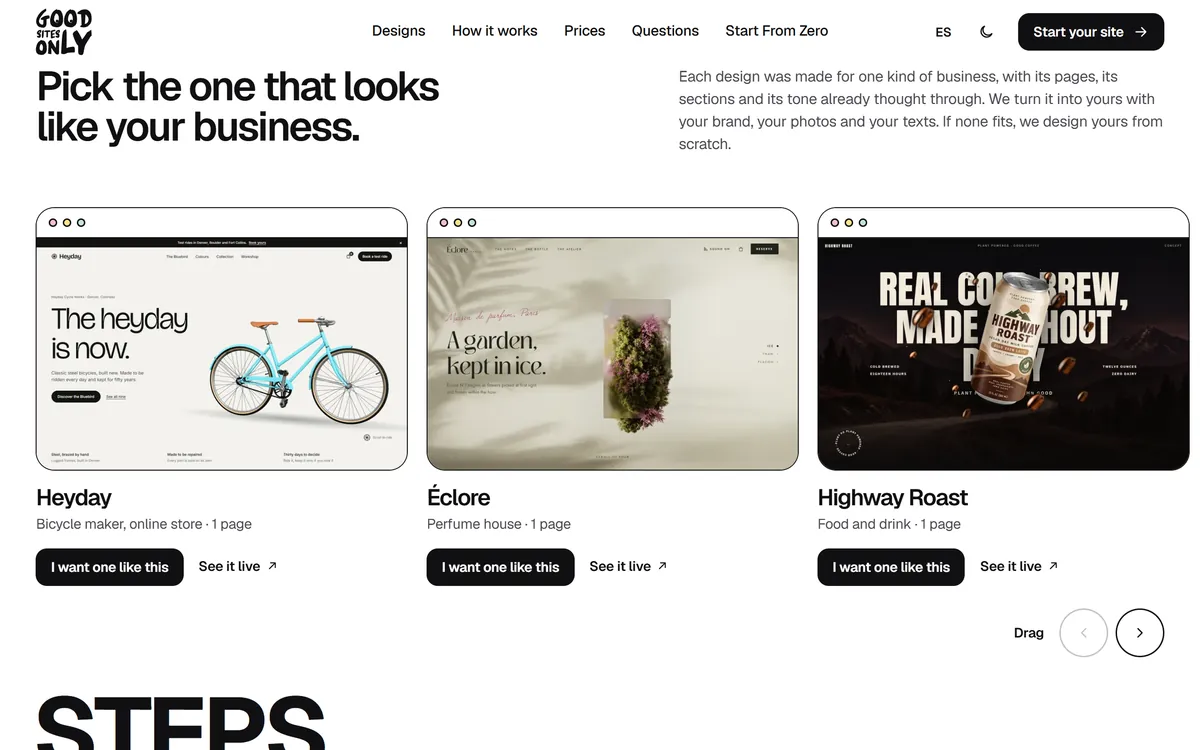
Every site includes hosting, a design made for your industry, a mobile version, SEO setup and contact forms. You can see the starting points in our designs. If you try a builder first and decide it is not for you, that is a perfectly good way to find out what you want.
Questions people ask
Is it better to use a website builder or hire a designer?
It depends on your time, your budget and how much you need to stand out. A builder is cheaper and faster to start, but the work is yours. A designer costs more and saves your time, and can give you a look and texts that templates do not.
Are website builders good enough for a small business?
For many, yes. A simple business with a clear offer can do well on a builder. Where builders struggle is with unusual features, a distinctive look and the time it takes you to write and arrange everything. If you can keep your site clear, fast and up to date, the tool matters less than the content.
Can I start with a builder and switch to a custom site later?
Yes. Keep your domain, texts and photos, expect to rebuild the design, and set up redirects so that old web addresses lead to the new pages. Plan the move before you start.
Which website builder is best for a small business?
There is no single best one. Popular names include Wix, Squarespace and GoDaddy, plus Shopify for stores. They differ in templates, tools, support and price, and plans change often. Try the free plans or trials with your real texts and photos, and check what each paid plan includes.
Is WordPress better than a website builder?
It is more flexible and more demanding. WordPress gives you freedom to change almost anything, but someone must handle hosting, updates, backups and security. A builder does that for you, with less freedom. Neither is better in general. The better one is the one you or your helper can keep running well.
Is a custom website worth the money?
It can be, if your site must build trust, stand out or do more than show pages. Estimate what one new customer is worth to you over a year, and divide the first-year cost of the site by that number. That shows how many customers it needs to win.
Do custom websites rank better on Google?
Not automatically. Google looks at content, relevance, speed, mobile experience and reputation. Both custom and builder sites can do well, or badly. Be careful with anyone who guarantees a ranking.
Will I own my website?
Ask before you start. On a builder, your content stays on the platform and the design usually cannot be moved. With a studio, ask what files you receive, who holds the domain and where the site is hosted.
What about AI website makers?
They can give you a first draft in minutes. You still need to check every fact and text, replace generic photos, test the phone version and add the legal pages. A draft is only as good as the information you give it.
How long does each option take?
A builder can take days if your content is ready. Guides put professional small business sites at about four to eight weeks, and custom-designed work often longer. Our own process takes 7 days. A later lesson explains the stages.
Want a website that does all of this? Start your site