How to choose a web designer or studio
Choosing who builds your site is one of the biggest decisions in the project. Use this guide to shortlist, compare and hire with confidence.
Choosing who builds your website is one of the biggest decisions in the project, and most owners make it with very little information. This lesson shows you the kinds of providers, how to build a shortlist, what to look for in a portfolio, which questions to ask and which red flags to avoid. It also covers what a fair contract should say, so you know who owns your site when the work is done.
Four kinds of providers
A freelancer
One person who designs and builds. Freelancers are flexible and often cost less than a studio. The risks are availability and gaps in skills, because one person may be strong in design and weak in writing or setup. A good fit for simple or medium sites when you already have a clear plan.
A small studio
A few specialists, such as a designer, a writer and a developer, working with a process. A studio costs more than a freelancer, and it gives you more guidance and a team behind your project. A good fit for small businesses that want help with decisions.
An agency
A larger team that also offers strategy, advertising and long-term marketing. Agencies are strongest for big projects and bigger budgets. For a small local business, much of what they offer may be more than you need.
A friend or relative
Someone you know who builds sites. It can be inexpensive and warm. It can also be risky if nothing is in writing: who will answer when something breaks in a year, and who holds the logins? If you go this way, put the basics in writing too.
How to build a shortlist
- Ask other owners. Find businesses whose sites you admire and ask who built them, and whether they would hire them again.
- Search with your industry and your city. Phrases like "web design for dentists" or "web design in Phoenix" show who works with businesses like yours.
- Check the footer of sites you like. Many studios sign their work there.
- Look at each candidate's own website. A designer whose own site is unclear, slow or out of date is telling you something.
- Keep three names. Enough to compare, few enough to talk to each one.
What to look for in a portfolio
A portfolio is the best evidence a provider has. Look at it with these points in mind.
- Range. Different businesses with different looks, not one look repeated with new logos. Range shows that the designer thinks about each business.
- Businesses like yours. At least some with similar needs, such as booking, a store or a service area.
- Sites that are live and working. Open them. Click around. Send a test message through a form.
- The phone experience. Open each site on your phone, not only on a computer.
- Speed. Do the pages open quickly on your phone?
- A clear first screen. Can you tell in five seconds what the business does and what to do next?
- Good words. Many sites have beautiful design and empty text. The words sell as much as the pictures do.
- Real results. Ask what changed for a client. Be careful with big claims that have no evidence behind them.
Range: the look should fit the business
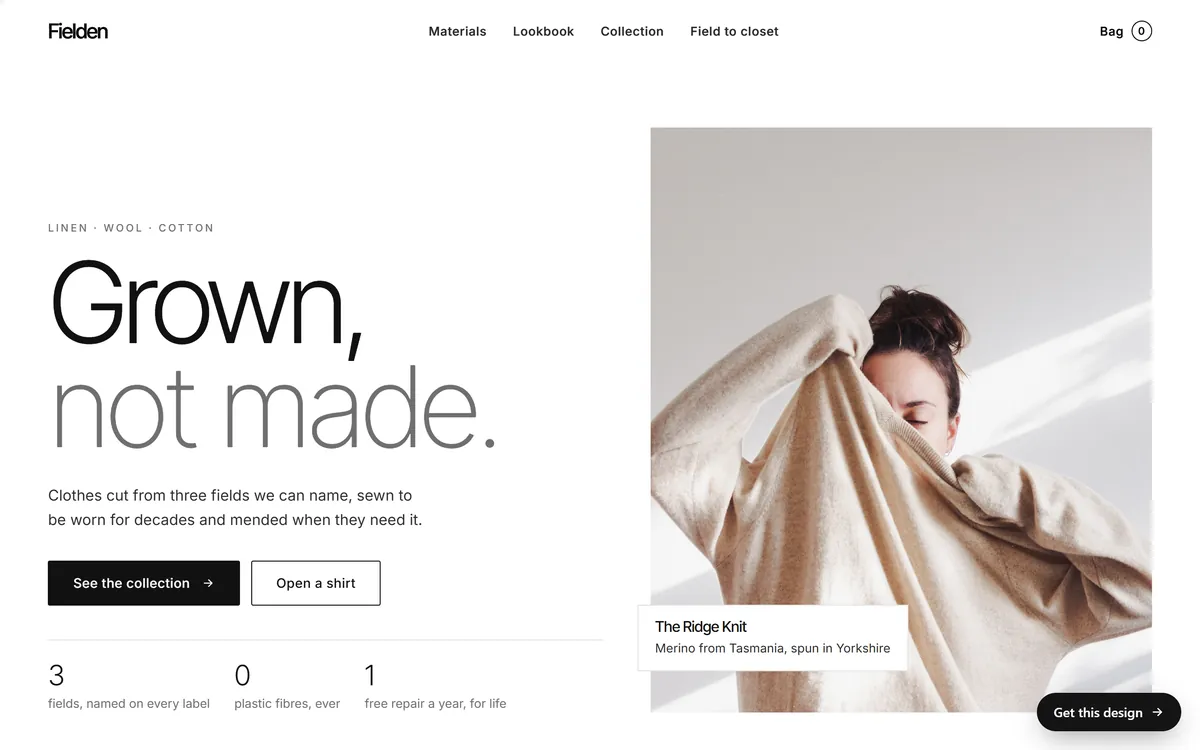
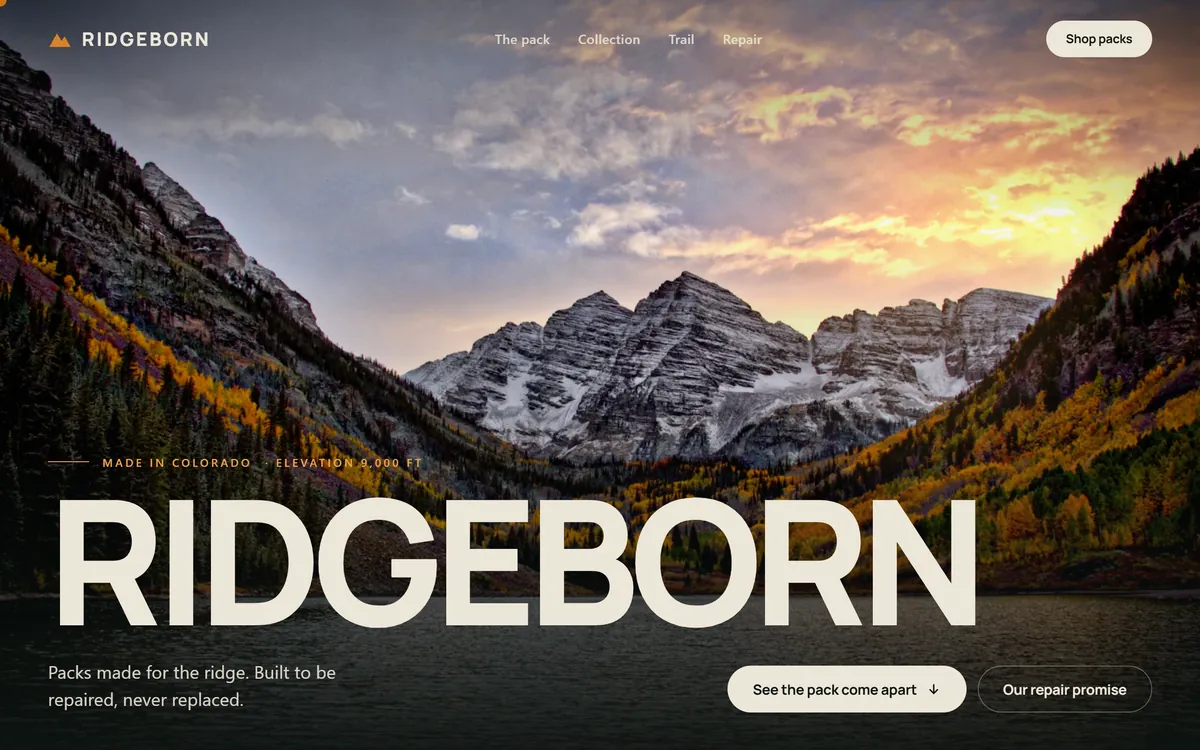
The three concept sites below come from three different industries, and none looks like the other. A clothing brand gets a light, editorial page with plenty of white space and a large portrait. An outdoor gear brand gets a full-width mountain photo and a huge name. A perfume house gets a soft, warm palette with a single object at the center. That is what range looks like: the look is chosen for the business, not for the studio.

Questions to ask before you hire
About the work
- Who will do the work, and will I speak with that person?
- What are the stages of the process?
- How many pages are included, and what is on each?
- Who writes the texts and who chooses the photos?
- How many rounds of changes are included?
- How long will it take, and what are the dates?
About the price
- What exactly does the price include?
- What is extra, and how is it priced?
- How much do I pay, and when?
- What is the total for the first year, and for the second?
About ownership
- After I pay, who owns the site, the design, the texts and the photos?
- Will the domain be registered in my name?
- Who has the logins, and will I have them too?
- Can I move the site elsewhere if I want to?
About life after launch
- What support is included, and for how long?
- Who updates the site, and what does a care plan cover?
- What happens if something breaks?
- How do I reach you, and how fast do you reply?
How to run the first call
Come with the plan from the previous lessons. Explain your business in two minutes, then listen. A good provider asks about your customers, your goals and your deadline before talking about colors or prices. Take notes, ask each question from the list above and ask for a written proposal that names the scope, the price and the dates. If the call felt rushed or full of jargon, that is useful information too.
How to check references
Ask for two or three past clients, and call or write to them. Ask what the project was like, whether the work arrived on time, how the provider reacted when something went wrong and what happened after launch. Ask what the client would do differently. Then open the client's website yourself. A reference who is happy and a site that works well are the best evidence you can get.
How to lower the risk
If you are unsure, start smaller. Ask for a first phase with the core pages, and add the rest later. Pay in stages that match the work, not everything up front. Keep copies of everything you send and receive. Save the logins and the files as soon as they are delivered. These habits protect you whoever you choose.
What a good client does
The relationship works in both directions. Reply quickly, give clear feedback in one list, deliver your content on time, pay on schedule and tell the provider early if something changes. Providers do their best work for clients who make their job easy, and projects with a good client usually finish sooner and cost less.
Red flags
- No portfolio, or a portfolio that is not theirs. Also no references.
- A guarantee of the first page on Google. Nobody controls Google. Promises like "first page in 30 days" are a warning.
- A vague scope and a vague price. "We will figure it out" means you will pay for the figuring.
- Nothing in writing. No contract, no list of what is included.
- Your domain or hosting in their name. Some providers hold them as leverage. Your domain should be registered to you.
- Pressure. "This price ends today" is a sales tactic, not a reason.
- Slow or unclear communication before you have paid. It rarely improves afterward.
- No questions about your business. A provider who does not ask about your customers and goals is not planning to build for them.
- A price far below the rest, with no explanation. Find out what is missing.
- A refusal to say who does the work.
Green flags
- They ask about your customers and your goals before they talk about design.
- They show their process and give dates.
- They speak in plain words and explain what each thing is for.
- They give you a clear scope and say what is not included.
- The domain and hosting are in your name, or can be transferred to you.
- They show real work and give references gladly.
- They are honest about limits, for example "that feature costs more" or "you do not need that yet".
- They talk about phones, speed and accessibility without being asked.
What a fair contract should say
A contract does not need to be long. It does need to cover these points.
- The scope: the list of pages and features.
- What you will receive, and when.
- What you must provide, and by when.
- The price and the schedule of payments.
- The number of rounds of changes.
- Ownership of the design, texts and photos once you have paid.
- The domain, the hosting and the logins.
- Support after launch, and for how long.
- How either side can end the agreement.
This is a guide, not legal advice. For a large project, ask a lawyer to read the contract.
How to compare two or three proposals
Ask each provider to quote the same list. Then compare them on six points: how well they understood your business, the price, the scope, the time, the ownership terms and how you felt talking to them. Do not choose by price alone. The cheapest proposal often leaves things out, and the most expensive does not always include more. Many owners find that the provider they trust to communicate is the one who gives them the best result.
How we answer these questions
Here is what we can tell you about our work, using the list in this lesson. Every site includes hosting, a design made for your industry, texts written for you, a mobile version, SEO setup and contact forms. Our process takes 7 days, in stages with one round of changes each, and you see the date of each stage. Monthly services, such as Care maintenance, Google Business management, email marketing, a 24/7 chat assistant, review requests and a landing page of the month, can be added when you want them. Use the questions in this lesson with us, and with anyone else you consider. You can judge our work yourself in our designs.
Questions people ask
How do I choose a good web designer?
Look at their portfolio for range and for sites that work well on a phone, ask for references, compare proposals on the same list and choose the one who understands your business and communicates clearly. Trust how the first conversations feel, because the project will feel the same.
How much should I pay for a web designer?
It depends on the kind of provider and the size of the site. Guides for 2026 put freelancers at roughly $1,500 to $8,000 and studios or agencies at about $3,000 to $15,000 for a typical small business site. Check what each price includes.
Should I hire a freelancer or an agency?
A freelancer suits a simple site and a clear plan. A studio suits owners who want guidance and a team. An agency suits large projects with marketing. For most small local businesses, a freelancer or a small studio is enough.
What questions should I ask a web designer?
Ask about the work, the price, the ownership and the support after launch. The lists in this lesson give you more than twenty questions to start with.
How do I know if a web designer is legitimate?
They show real, working sites that they built, give references you can call, explain their process and put the scope and the price in writing. A designer who avoids all of this is a risk.
What are the red flags when hiring a web designer?
No portfolio, no contract, a vague price, pressure to sign today, a guarantee of Google rankings, and a domain or hosting registered in their name instead of yours.
Who should own my website and my domain?
You should. Make sure the domain is registered in your name and that you have the logins. Ask in writing who owns the design, texts and photos after you pay.
Do I need a contract?
Yes. It protects both sides. It should list the scope, the price, the schedule, the ownership and the support. A short, clear contract is better than a long one that nobody reads. For a large project, ask a lawyer to review it.
Can a web designer guarantee the first page of Google?
No. Rankings depend on your competition, your content, your reputation and decisions by Google. A good provider can set up your site correctly, but cannot promise a position.
Should I choose a local designer?
Location matters less than fit, process and communication. Some owners like to meet in person, and a local provider may know your market well. What counts most is that the provider understands your customers and answers quickly, wherever they are.
Want a website that does all of this? Start your site