Your growth plan for the next 12 months
You have all the pieces. Put them on one page with goals, a calendar by quarter and review dates, and work the plan at your own pace.
You now have all the pieces: a brand, a domain, a plan for your site, words that sell, a presence on Google, social media, email, ads and the numbers to measure them. This last lesson puts them together in a one-page growth plan for the next twelve months, with goals, a calendar by quarter and review dates.
What you have built in this course
Over ten series you covered the whole path from an idea to a business that measures itself.
- Your brand. A name, a logo and the colors, fonts and voice that make you recognizable.
- Your domain, hosting and email. Your web address, the place where your site lives and a professional email.
- Planning your website. What the site needs, what it costs and who should build it.
- Design that sells. A site that looks professional on every phone, loads fast and leads visitors to call or book.
- Words that sell. The pages, headlines and answers that turn visitors into customers.
- Get found on Google. SEO, your Google profile and reviews.
- Social media from zero. The right networks, what to post and how to turn followers into visits.
- Email and customers who come back. A list, emails people open and customers who return.
- Ads that pay off. Paid ads on Google, Facebook and Instagram without burning money.
- Measure and grow. Reading your numbers, keeping your site healthy and planning the next twelve months.
A growth plan joins all of this on one page, so that you know what to do this month and why.
What a growth plan is
A growth plan is a short document that answers six questions.
- Where are we now? Your numbers and your starting point.
- Where do we want to be? One to three goals with a number and a date.
- What will we do? A few channels and the actions for each one.
- When? A calendar by quarter, with the monthly routine inside it.
- What will it cost? The budget from lesson 10-9.
- How will we know? The measures and the dates when you look at them.
It fits on one page. If it takes ten pages, nobody will follow it, including you.
Step 1: write down where you are
Use the record you started in lesson 10-2. Write the five numbers for the last month, and for the same month last year if you have it. Add a few lines about what is working and what is weak, and one or two comments from customers. If you have no data yet, that is fine. Start the record now, and let your first quarter be the baseline.
Step 2: choose one to three goals
A good goal has three parts: an action, a number and a date. It is about something you can influence.
- Weak: get more customers.
- Better: receive 8 booking requests a month from the website by December.
Here are more examples. They are only illustrations, and you should choose numbers that fit your own business.
- Collect 30 new reviews by the end of the year.
- Reach 300 subscribers on the email list by September.
- Raise the share of visitors who send the contact form from 2 percent to 3 percent by the end of the second quarter.
- Publish one useful page or article every month for twelve months.
Avoid goals that depend on things you do not control, such as a position in search results. Limit yourself to three goals, because every extra goal takes time from the others.
Step 3: choose your channels and actions
Pick two or three channels that fit your customers and your time: Google search and your Google Business Profile, email, social media, referrals or paid ads. For each goal, write down three actions. A goal about reviews might have these actions: ask five customers a month, reply to every review and add the review link to your invoices. A goal about booking requests might be: improve the booking page, test a shorter form and send one email a month.
Step 4: map the year by quarter
Use the quarters as themes, and shift them to match your own seasons.
Quarter 1: foundation
- Write the baseline and the goals.
- Check that your measurement works, and mark your key events.
- Fix the basics of the site: forms, speed, the mobile view, contact details.
- Complete your Google Business Profile, and start asking for reviews.
- Review your privacy page and your tools, as lesson 10-5 explains.
- Start the monthly routine.
Quarter 2: visibility
- Publish useful content every month, based on customer questions and Search Console queries.
- Grow your email list and send your first regular emails.
- Keep asking for reviews, and answer every one.
- Choose where to be present on social media, and keep it modest.
Quarter 3: conversion
- Improve your three most visited pages, one change at a time.
- Test your forms and your buttons, as lesson 10-3 explains.
- Prepare for your busy season with a clear page or offer.
- If your numbers are ready, run one small paid test with a cap.
Quarter 4: loyalty and planning
- Write to past customers, thank them and tell them what is new.
- Review the year against your goals.
- Decide whether the site needs a repair, a refresh or a redesign, using lesson 10-7.
- Set next year's budget and write next year's plan.
Plan around your seasons
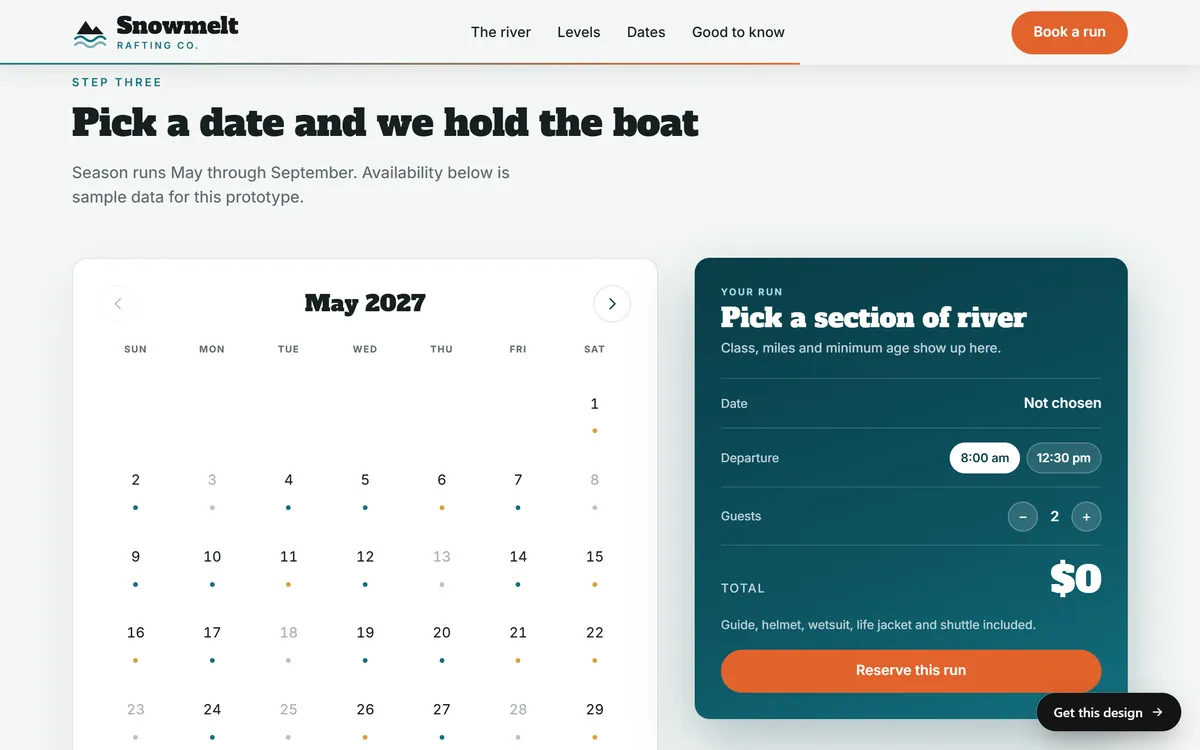
Few businesses have a flat year. A restaurant changes its menu with the harvest, a river outfitter works a season, a clothing brand sends a note each season and a lodge plans around the calendar. Your plan should follow your own curve.
- Prepare before the busy season. Fix pages, test forms and send emails in the weeks before customers arrive.
- Use the quiet season to build. It is the best time to improve the site, write content and collect reviews.
- Put dates in the plan. Menus, trips, collections and availability should be updated on a schedule, not when you remember.
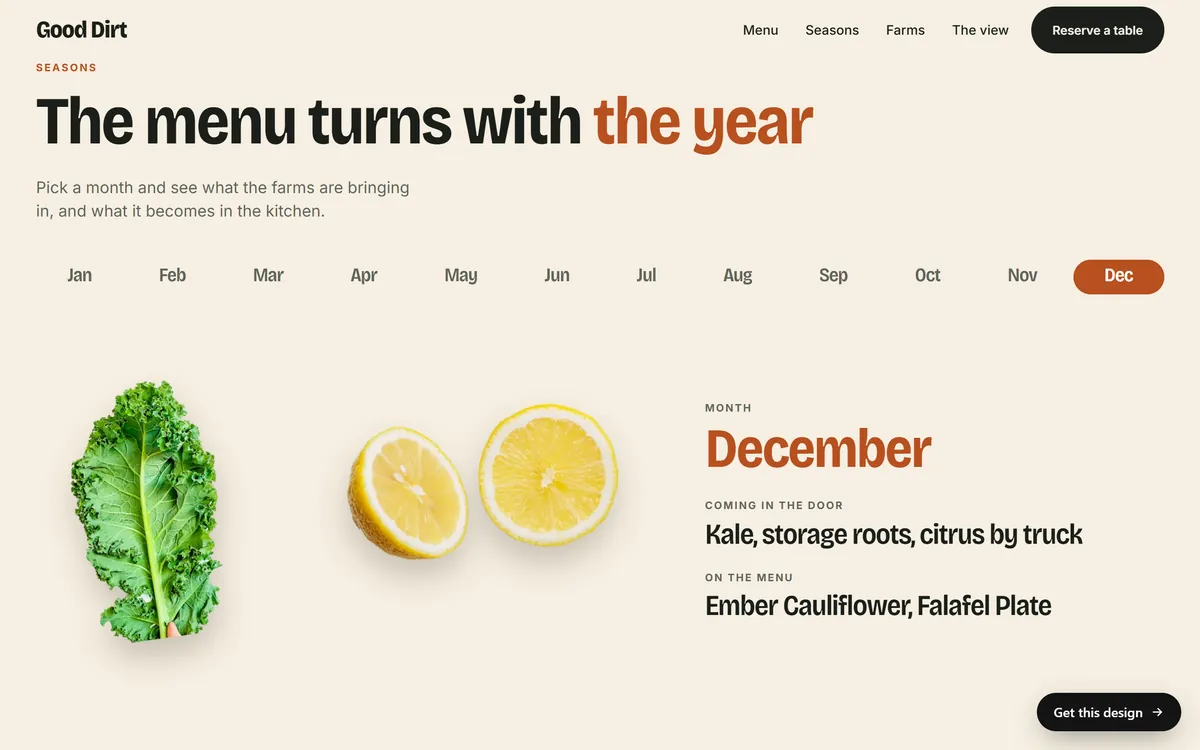
A menu that changes by month, a season that runs for a few months, a letter that goes out four times a year: each of these gives your plan a natural rhythm.
Step 5: put the routine on the calendar
Open your calendar and block twelve dates now, one for each monthly session from lesson 10-8. Give each one a name, such as "Marketing: two hours". A plan that lives only in a document does not happen. A plan that lives in your calendar has a chance.
Step 6: set the budget
Use lesson 10-9 to write the budget lines for the year: fixed costs, variable costs, yearly renewals and the value of your time. Place the larger amounts in the quarters where they matter most, and keep a small amount for experiments.
Step 7: schedule your reviews
Every month: the routine
Read your numbers, check Search Console, test the site, update your profile, ask for reviews, publish one thing and send one email.
Every quarter: a deeper review
- What did we achieve against each goal?
- What worked? Do more of it.
- What did not work? Stop it, or change it.
- Is the budget right? Raise, lower or move lines.
- What is the plan for the next quarter?
Every year: the big picture
Review the whole year, write the plan for the next one and decide whether the site needs a bigger change.
A one-page plan you can copy
- The business in one line. What you sell and to whom.
- Where we are. The five numbers and a few notes.
- Goals. One to three, each with an action, a number and a date.
- Channels and actions. Two or three channels, three actions each.
- Calendar. The four quarters, with the key dates of your seasons.
- Budget. The lines and the amounts for the year.
- Owners. Who is responsible for each action.
- Review dates. The monthly sessions, the quarterly reviews and the annual review.
A sample plan, so you can see the shape
This plan is invented, for a neighborhood bakery that sells bread and takes orders for custom cakes. Every number in it is made up for the example.
- Where we are. About 600 visitors a month, 12 cake order requests a month and 20 reviews.
- Goals. Reach 20 cake order requests a month by October. Collect 60 reviews by December. Grow the email list to 250 subscribers by September.
- Channels. The Google Business Profile and search, email and referrals.
- Quarter 1. Fix the order form, the hours and the photos. Start asking for reviews.
- Quarter 2. Publish pages and photos for the wedding and graduation seasons. Start the email list.
- Quarter 3. Improve the cake order page one change at a time. Prepare the holiday order page.
- Quarter 4. Launch the holiday order page before the busy weeks. Send a thank-you email to past customers. Write next year's plan.
- Budget. Hosting, the email platform, one photo session and a small capped test in the fourth quarter.
- Reviews. A session on the first Monday of each month, and a deeper review at the end of every quarter.
It is one page, it has dates and it can be done by one busy owner. That is the standard to aim for.
When the plan slips
It will, at some point. A busy month, a sick employee or a slow quarter will push the plan off course. The answer is to shrink the plan, not to abandon it. Do the forty-five-minute version of the routine. Drop a goal for a quarter. Move an action to the next one. Then write down what happened and what you changed. A plan that bends and keeps going beats a perfect plan that you stop following in March.
Planning mistakes to avoid
- Too many goals. Three is the limit.
- Goals without dates. A goal with no date is a wish.
- Actions without owners. If no name is next to the action, it will not happen.
- Planning without data. Start from your numbers, not from a guess.
- Ignoring your seasons. A flat plan for an uneven year wastes effort.
- Never reviewing. A plan you do not look at is only a document.
You have finished Start From Zero
You can now name a business, choose a domain, plan a website, write the words, get found on Google, show up on social media, write to your customers, test ads, read your numbers and plan a year. That is a lot to know, and you can use all of it at your own pace. Pick the first date on your calendar and put your plan to work whenever it suits you. If you decide to build or rebuild your site, you can start your site, and you can look at finished sites in our designs first.
Questions people ask
What is a growth plan?
It is a short document that sets your starting point, one to three goals, the channels and actions you will use, a calendar, a budget and the dates when you will review your progress.
How do I create a 12-month growth plan for my small business?
Write down where you are, choose one to three goals with a number and a date, pick two or three channels, map the year by quarter, put the monthly routine on your calendar, set the budget and schedule your reviews.
How many goals should I set?
One to three. Each extra goal takes time and money from the others, and a small business rarely has enough of either.
What are good goals for a small business website?
Goals about actions you can influence: booking requests or inquiries per month, new reviews, email subscribers, the share of visitors who send a form, or a content schedule you keep for the whole year.
How do I plan around busy and slow seasons?
Prepare your pages, forms and emails in the weeks before your busy season, and use the quiet season to build: improve the site, write content and collect reviews. Put the dates of your seasons on the calendar.
How often should I review my plan?
Look at your numbers every month in your routine, hold a deeper review every quarter and review the whole plan once a year.
What if I do not reach my goals?
Look at what happened. Ask whether the goal was realistic, whether the actions were done and whether something outside your control changed. Then adjust the plan and keep going. Missing a goal is information.
How much time does a growth plan take each month?
The two-hour monthly routine from lesson 10-8 covers the regular work. The plan itself takes an hour or two to write at the start and a short review each quarter.
Should I plan for the whole year or just the next quarter?
Do both. Sketch the whole year in outline, so the seasons and the big dates are visible, and plan the next quarter in detail. Rewrite the next quarter at each review.
When should I redesign my website as part of the plan?
Decide at your annual review, using the signs in lesson 10-7. If the site works for your goals, keep improving it. If the structure is what holds you back, add the project to the plan with its own budget and dates.
Want a website that does all of this? Start your site