Bilingual websites for Florida businesses
Census figures by county, Google's rules for two languages and the mistakes to avoid.
More than one in five Floridians aged five and older speaks Spanish at home: 4.8 million people, according to the Census Bureau's five-year survey for 2020 to 2024. In Miami-Dade it is two in three. If your customers live in Florida, a real share of them would rather read your website in Spanish, and 43% of those say they speak English less than "very well". This guide covers what the numbers say about your county, what Google asks of a site in two languages, what to put in each version and how we build one.
The short version
- Spanish is the home language of 22.6% of Floridians over five. Across the United States the figure is 13.6%.
- About two million of them speak English less than "very well". For them, a site in English only is a site they cannot fully use.
- People buy in their own language. In a 29-country survey by CSA Research, 76% of online shoppers preferred product information in their native language, and 40% said they never buy from websites in other languages.
- Google wants one address per language. Its guidance asks for separate pages for each language, one language per page and no automatic redirects.
- Write each version for its reader. A translate button that changes the words inside the visitor's browser gives Google nothing to index in Spanish.
How many of your customers speak Spanish?
The Census Bureau's American Community Survey asks households which language they speak at home and how well they speak English. These are its latest five-year figures for the largest metro counties in Florida, next to the state and the country.
| Area | Speak Spanish at home (age 5 and older) | Of them, speak English less than "very well" | Hispanic or Latino residents |
|---|---|---|---|
| Miami-Dade County (Miami) | 66.7% | 48.4% | 69.3% |
| Broward County (Fort Lauderdale) | 28.5% | 40.1% | 32.8% |
| Orange County (Orlando) | 26.2% | 40.8% | 33.8% |
| Hillsborough County (Tampa) | 23.0% | 43.4% | 30.4% |
| Florida | 22.6% | 43.3% | 27.4% |
| United States | 13.6% | 40.2% | 19.3% |
Source: U.S. Census Bureau, American Community Survey, five-year estimates for 2020 to 2024, tables C16001 and B03003.
Two things stand out. First, the share of Hispanic residents is higher than the share who speak Spanish at home, because many Hispanic families speak only English at home. Plan with the first column, not the last. Second, the middle column is the group that needs Spanish to understand your services, your prices and your forms. The rest are bilingual, and most people still prefer to buy in their native language.
Your own county may look different from these five. The same Census tables cover every county and most cities in Florida, and they take a minute to read: the links are in the sources at the end of this page.
Which businesses need Spanish first
Any business can add a second language, but some lose customers faster without one. The pattern is the same in each case: the customer has to understand something specific before they call, book or pay.
- Health: dentists, clinics, therapists and pharmacies, where people need to understand a treatment, a cost or an insurance question before they book.
- Legal and money: immigration, family and injury law, tax preparation, insurance and loans, where a misunderstanding costs real money.
- Home services: plumbers, roofers, cleaners, pest control and air conditioning, where the customer compares quotes and wants to know exactly what is included.
- Restaurants and shops: menus, hours, delivery areas and ordering.
- Schools, real estate and car repair: forms, contracts and explanations that people read more than once.
If customers already switch to Spanish halfway through a call, or someone on your staff translates for them at the counter, your website is the next place to do the same.
What Google asks of a site in two languages
Google's documentation for sites in several languages is short and specific. These are its main points, in plain words.
- A separate address for each language. Google recommends a different URL for each language version, such as
/es/for Spanish, rather than changing the words with cookies or browser settings. Its crawler usually visits from the United States and does not ask for a language, so a page that turns Spanish only for some visitors may never be found. - Labels that connect the versions. Each page tells Google where its version in the other language lives, with hreflang annotations or in the sitemap.
- One language per page. Google decides the language of a page from its visible text, not from its code, and asks for a single language in the content and the navigation. Side-by-side translations on one page confuse readers and search engines alike.
- No automatic redirects by language. Sending people to a version based on a guess about their language can hide the other version from them and from Google. A visible link to the other language on every page does the job better.
The practical consequence: your Spanish pages can show up in searches written in Spanish only if they exist as real pages with their own address. A site in English with a translate button is, for Google, a site in English. If you are also working on showing up in your city, our lesson on local SEO covers the rest.
Translated, or written in Spanish?
There are three ways to get a Spanish version, and they are not equal.
| Approach | What the customer reads | What Google sees |
|---|---|---|
| A translate button that changes the text in the visitor's browser | Automatic Spanish, with mistakes in names, prices, dates and anything specific to your business | No Spanish pages to index |
| Your English pages translated word for word | Correct Spanish that reads like a translation, often longer and stiffer than the original | Spanish pages that can be indexed, built around the words people use in English |
| Each version written for its reader | Spanish that sounds like you talking to the customer, with the same facts and the same prices | Spanish pages built around the words people use when they search in Spanish |
Florida's Spanish speakers come from many countries, so we write in a neutral Spanish that reads naturally to all of them, and we use local words where you know your customers use them. Names of services, prices, hours and addresses stay identical in both versions, because those are the facts people act on.
What to translate first, and what can wait
| Translate from day one | Can follow later |
|---|---|
| Home page, services and prices | Blog posts and news |
| Contact page, booking and every form, with its error messages | Old projects and archives |
| Confirmation emails and the thank-you page after a form | Downloadable documents you rarely update |
| Menus, buttons, and the titles and descriptions that show in search results | |
| Image descriptions (alt text) and the language setting of each page |
The last row matters for more than search. Screen readers use the language setting of a page to pronounce its words, and WebAIM's 2026 scan of the top million home pages found that setting missing on 13.5% of them. A Spanish page marked as English is read aloud with English pronunciation. Our guide to website accessibility for Florida businesses covers this and the other common errors, and forms deserve their own care in both languages: see contact forms people actually fill in.
Mistakes we see on bilingual sites
- Half-translated pages. The text is in Spanish, but the menu, the buttons or the form still speak English.
- Forms that answer in English. The visitor fills in a form in Spanish and gets a confirmation email they cannot read.
- A Spanish page with no way back. Every page should link to its version in the other language, always in the same place.
- Guessing the language. Redirecting people by their browser settings or their location sends bilingual customers to the version they did not choose.
- Flags instead of words. A flag stands for a country, not a language. We label the switch "Español" and "English".
- Two sites that drift apart. A price changes in English and stays old in Spanish. Both versions need the same owner and the same update routine.
How we build a bilingual site
Good Sites Only builds websites in English and Spanish as one site with two languages. This is how it works.
- You tell us at the start. When you start your site, say you need both languages. Your proposal shows the price with both included.
- We write both versions. Each one is written for its reader, with the same services, prices and contact details.
- Each language gets its own pages. English at the usual address and Spanish at its own, such as
/es/, connected for Google and with a language switch on every page. - Forms and emails in each language. Whoever writes to you in Spanish gets the confirmation in Spanish.
- Someone on your team reviews the Spanish. You name a person who speaks it, and they check the texts before launch, the same way you approve the English ones.
Our own website works this way: goodsitesonly.com in English and goodsitesonly.com/es in Spanish, each with its own address and a language switch at the top.
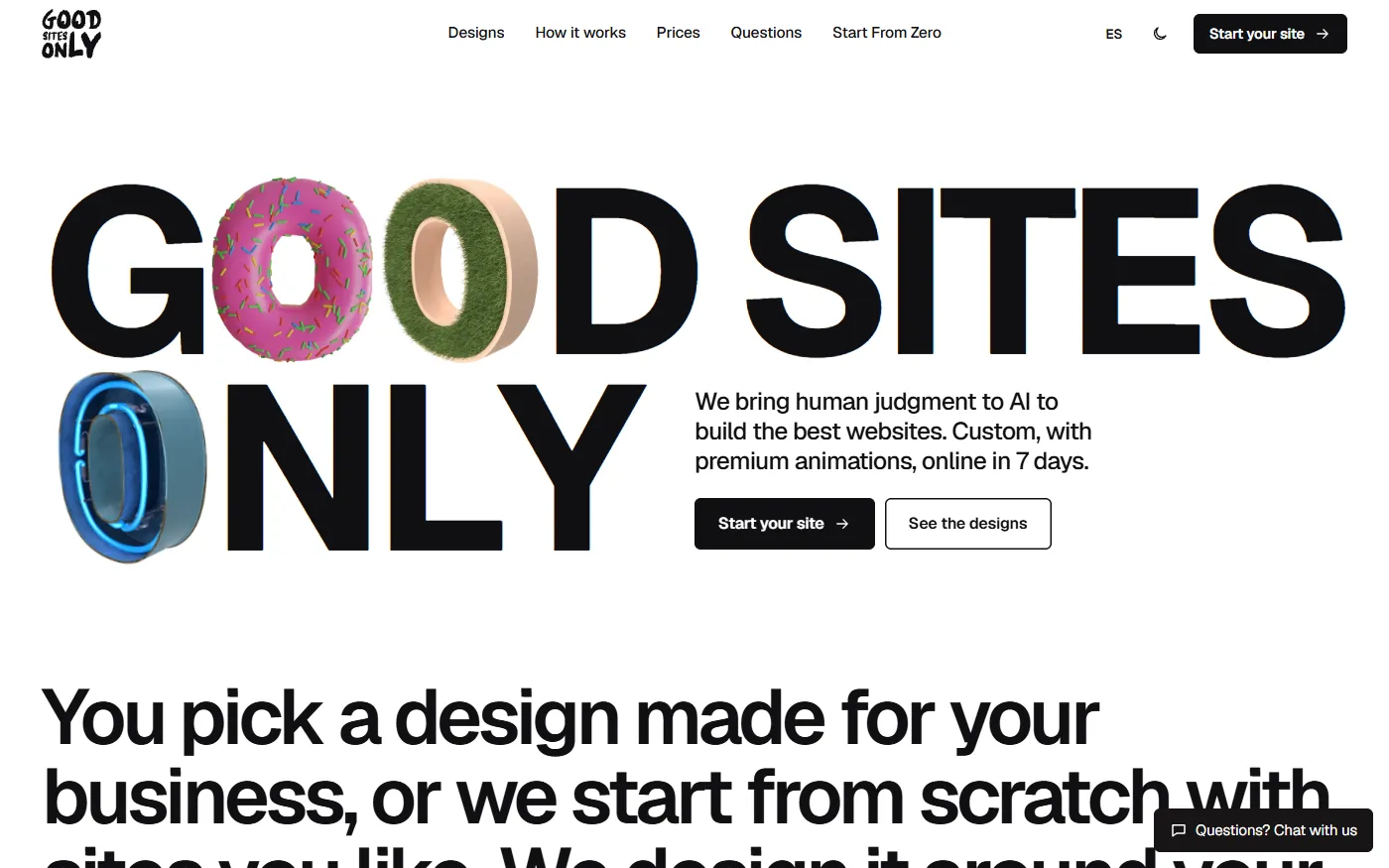
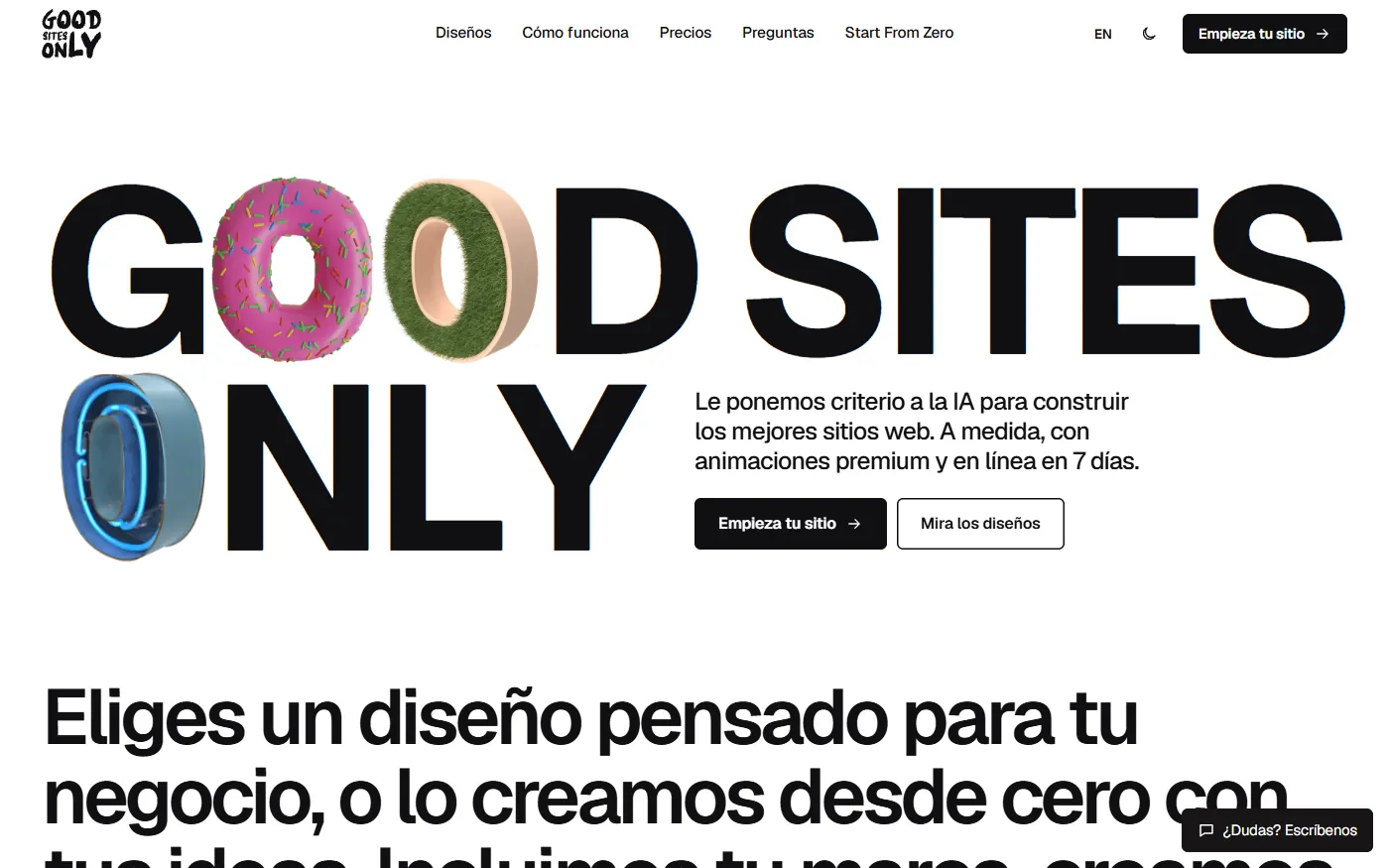
Every one of our designs can be built in both languages. When you are ready, start your site and tell us which languages your customers speak.
Questions
Does my Florida business need a bilingual website?
Look at two things: your county in the table above and your own customers. If one in five people near you speaks Spanish at home and your phone already rings in Spanish, a site in English only is losing some of those customers before they call. If your customers are other businesses that work in English, a second language can wait.
Is it better to translate my website or write it in Spanish?
Writing each version for its reader works better. A literal translation is correct but reads like a translation, and it is built around the words people use in English. Keep the facts identical and let each version speak the way its customers do.
Does a Spanish version help my SEO?
It gives you a chance to appear in searches written in Spanish, which a site in English only does not have. That works when the Spanish pages have their own addresses, are connected to the English ones and use one language each, as Google's guidance asks.
Can I just add a translate button to my site?
You can, but it is not a Spanish website. A button that translates in the browser gives Google no Spanish pages to index, and automatic translation gets names, prices and specific terms wrong. It helps a visitor a little, and it falls short of what customers expect from a business that speaks their language.
Should the Spanish version have its own domain?
It does not need one. Google describes three ways to organize versions: separate domains, subdomains such as es.example.com and folders such as example.com/es/. For a small business a folder is the simplest: one site, one host and one place to update, which is how Google describes the advantages of that option.
How much does a bilingual website cost?
It depends on how many pages the site has and how much of it goes into Spanish. Tell us when you start and your proposal will show the price with both languages included. The prices of the site itself are in our packages.
Who checks the Spanish before it goes live?
We write it, and a person you choose on your team reviews it before launch. They know your customers and the words your business uses, so theirs is the final check.
Sources
- U.S. Census Bureau, American Community Survey 2024 five-year estimates, table C16001: language spoken at home and ability to speak English.
- U.S. Census Bureau, American Community Survey 2024 five-year estimates, table B03003: Hispanic or Latino origin.
- Census Reporter, table C16001 for Florida, its largest metro counties and the United States.
- CSA Research, "Consumers Prefer their Own Language", July 7, 2020, on its Can't Read, Won't Buy survey of 8,709 consumers in 29 countries.
- Google Search Central, managing multi-regional and multilingual sites.
- Google Search Central, tell Google about localized versions of your page.
- WebAIM, The WebAIM Million, 2026 report.
Need a website that brings in customers? Start your site