What is white label web design?
What it means, how it differs from outsourcing, reselling and referrals, and how a project and its margin work for an agency.
White label web design is when a studio designs and builds a website, and an agency sells it to its client under the agency's own name and at the agency's own price. The client deals with the agency and sees the agency's brand. This guide explains what the term means, how it differs from similar arrangements, how a project works, what it costs and what to ask before you choose a partner.
What white label means
The term comes from manufacturing. A company makes a product with a blank label, and other companies put their own name on it and sell it as theirs. The buyer sees one brand, and the maker stays in the background.
In marketing and web design the idea works the same way, applied to a service. One company does the work and another presents it as its own. The client hires the agency, the agency hires the specialist, and the agency answers to the client for the result.
For an agency this solves a common problem. Clients who buy ads, SEO or branding also need a website, and a design team is expensive to keep busy all year. With a white label partner the agency can say yes to the website, keep the client and pay for each project as it comes.
How does white label work?
Three parties take part, and each one has a clear role:
- The provider does the work: design, texts, development and checks. It charges the agency a fixed price, a rate or a subscription.
- The agency sells the service, sets the price, puts its brand on it and keeps the relationship with the client. Its income is the difference between what the client pays and what the provider charges.
- The client buys from the agency, pays the agency and judges the agency by the result.
The contract between the agency and the client is separate from the contract between the agency and the provider. That is why the agency is responsible to its client even when someone else did the work.
Examples of white labeling
You have bought white label products and services without noticing, because the point is that only one brand shows:
- Supermarket brands. A food company produces the olive oil or the cereal, and the supermarket sells it under its own name.
- Cosmetics. A laboratory makes a cream, and several salons sell it with their own label.
- Software. A company builds a reporting or scheduling tool, and consultants offer it with their own name and logo.
- SEO and ads. A specialist prepares the reports or runs the campaigns, and the agency delivers them to the client with its logo.
- Websites. A studio designs and builds the site, and the agency sells it as part of its services.
White label and the other types of brand
White label is one of several ways a product can reach the market. These are the types of brand you will see most often:
| Type of brand | Who makes it | Whose name is on it | Example |
|---|---|---|---|
| Manufacturer brand | The company that sells it | The maker | A drink sold under the name of the company that bottles it. |
| Private label, or store brand | A maker, to the specification of one retailer | The retailer | A supermarket's own line of groceries. |
| White label | A provider that supplies several sellers | Each seller | A cream sold by several salons, each one with its own label. |
| Co-branding | Two companies together | Both | A credit card that carries the names of a bank and an airline. |
The difference between white label and private label is exclusivity. In white label the same product goes to many sellers. In private label the product is made for one retailer. A website is made for one client, so the two ideas overlap in web design, and the industry uses "white label" for both.
White label, outsourcing, reselling and referrals
These four arrangements get mixed up often. The difference shows when you ask who sells, whose brand the client sees and who keeps the client:
| Arrangement | Who sells to the client | Brand the client sees | Who sets the price | Who keeps the client |
|---|---|---|---|---|
| White label | You | Yours | You | You |
| Outsourcing | You | Yours | You | You |
| Reselling | You | The maker's | Usually the maker's list price | It depends on the contract |
| Referral or commission | You or the provider | The provider's | The provider | The provider |
Outsourcing looks the same to the client. The difference is on your side: you direct the work task by task and often pay for hours, so you still need someone who can brief, review and manage a website project. With white label you buy a finished service with a known price and a known process.
Reselling means you sell someone else's product with their name on it, such as a software license. A referral or commission means you bring the client and the provider does the rest. Our program for sellers works that way: the seller closes the sale at our list price and earns a commission, and our studio deals with the client.
How a white label website project works
The steps are similar with most providers, even if the names change:
- You sell the site. You agree on the scope and the price with your client, under your brand.
- The studio gathers the information. The business, the services, the tone, the logo, the photos and the sites the client likes.
- The texts get written and approved. Each section goes to the client for approval, with the agreed number of changes.
- The design gets built and approved. The client sees a mockup, on a phone and on a computer, before the real site exists.
- The studio builds and checks the site. Speed, phones, links and forms get tested before anyone outside sees it.
- The site goes online. Your client receives the address and the access.
- The work continues. Maintenance, small changes, email or reviews, as monthly services that you can offer under your brand.
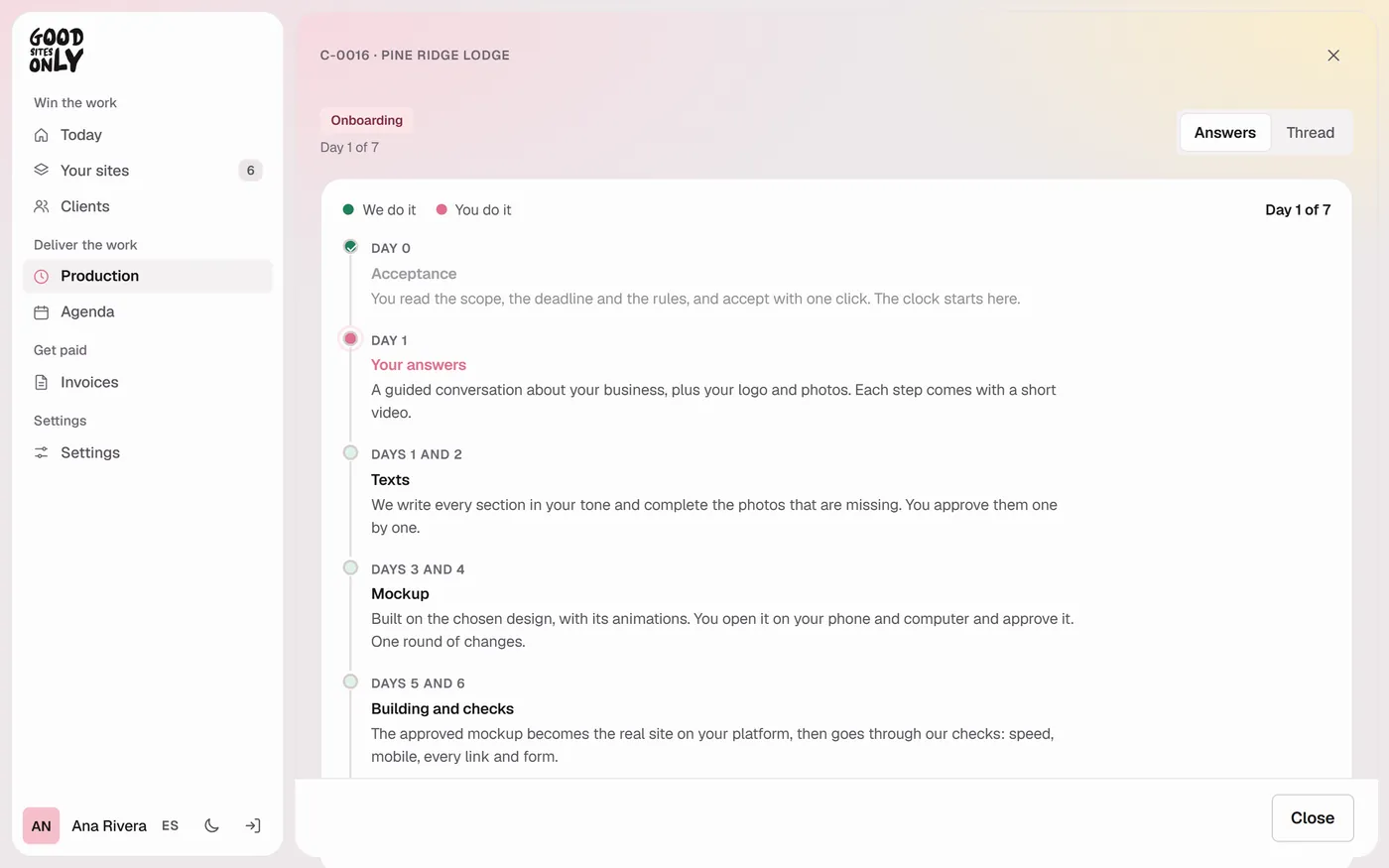
With our studio these stages take 7 days. The clock starts when you buy the site and pauses while we are waiting for you. You can see how it runs on our white label page.
How much does white label web design cost?
Providers charge in three ways: a fixed price per project, a rate per hour, or a monthly fee for a certain amount of work. Many do not publish prices, so ask for them in writing and check what they include: the number of pages, the texts, the rounds of changes and the hosting. A lower price can hide work that lands on your desk later.
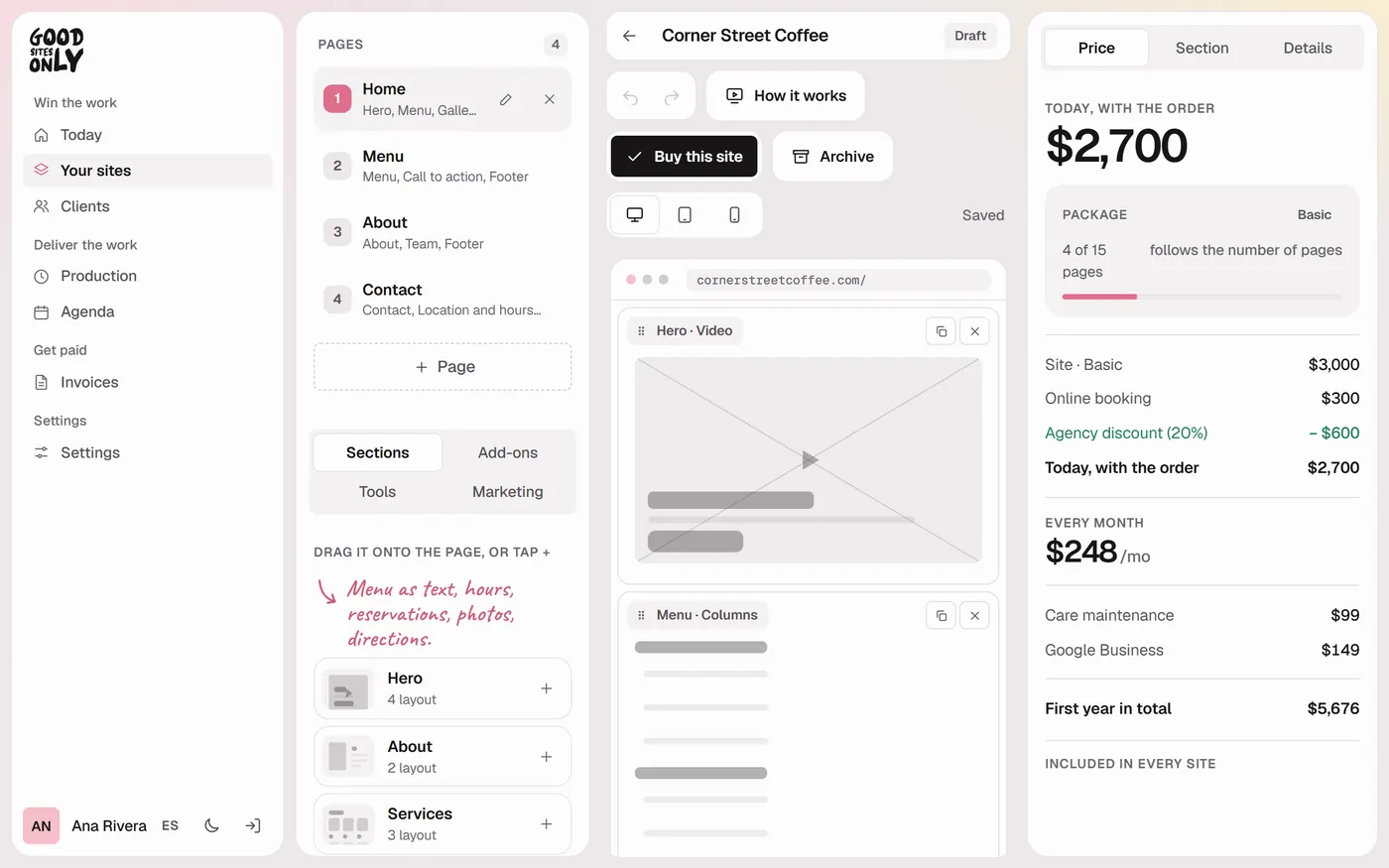
We publish ours. An agency pays 20% less than our list price on the site:
| Package | Pages | List price | The agency pays |
|---|---|---|---|
| Basic | Up to 15 | $3,000 | $2,400 |
| Pro | 15 to 30 | $5,000 | $4,000 |
| Large | More than 30 | $8,000 | $6,400 |
How an agency sets its price
Your price has to cover three things: what you pay the provider, the time your team spends on the sale and the follow-up, and your margin. Here is an example with a Basic site, assuming six hours of your time at $75 an hour:
| Item | Amount |
|---|---|
| What you pay the studio | $2,400 |
| Your time: 6 hours at $75 | $450 |
| Your total cost | $2,850 |
| The price you charge your client | $4,000 |
| Your margin | $1,150 |
These numbers are an example, and your market will decide what you can charge. Look at what the agencies and studios near you ask for a similar site, and remember that a site sold together with your ads or your SEO is worth more to the client than a site on its own.
Is white labeling legal?
Yes. White labeling is a normal commercial arrangement, and selling a service made by a provider under your own name is legal in itself. The trouble comes from what you promise and from what your contracts say. Keep these points in order:
- Tell the truth about what you offer. Do not claim awards, certifications or team members you do not have.
- Read the contract with your provider. It should allow you to resell the work under your brand, and it should say what happens to the site if you stop working together.
- Check the licenses. Fonts, photos and plugins have to be licensed for the client's use.
- Protect your client's information. Your provider will see their data, so agree on confidentiality in writing.
- Answer honestly if your client asks. You can say that you work with a specialist design studio. Most clients care about who is responsible, and that is you.
Rules change from one country to another, and physical products such as food and cosmetics have labeling laws of their own. For a specific contract, ask a lawyer in your country.
Advantages and risks for an agency
What you gain
- A new service to sell without hiring a team.
- A known cost per project, instead of salaries that run all year.
- Capacity that follows your sales, in busy months and in quiet ones.
- A larger share of what each client spends, because the website stays with you.
What you take on
- You answer to your client for work someone else does, including delays and mistakes.
- You depend on your provider's quality and capacity.
- Your margin has to pay for the time you spend on the sale and the coordination.
- Your client's approvals pass through one more link, so you need clear rules about who answers and when.
You can reduce most of these risks before you sell anything. Open the provider's finished sites on your phone, get the scope in writing and start with one small project.
Questions to ask a white label web design partner
- Can I open finished sites, live, on my phone?
- What does the price include: pages, texts, photos, rounds of changes and hosting?
- How long does each stage take, and what happens if my client is late?
- Does my client see only my brand, on the proposal, the project page and the emails?
- Does your name appear anywhere on the finished site?
- Who talks to my client during the project?
- Who owns the domain, the hosting and the site, and can a site be moved?
- What happens after the launch: updates, backups and small changes?
- Are there minimums or a long contract?
- How do you check quality before a site goes online?
Is white label right for your agency?
It makes sense if you already have clients who ask for websites, or clients whose website limits the results of the work you do for them. It also makes sense if you would rather spend your time on strategy and sales than on managing designers and developers.
Think twice if your clients need complex custom development, or if design is the reason they hire you. In that case the design work is your product, and you will want it close. If you have no clients yet, read how to start a web design agency first.
Questions about white label
What does white label mean?
That one company makes a product or does a job, and another sells it under its own name. The buyer only sees the brand of the seller.
What is an example of white labeling?
A supermarket brand made by a food company, or a website designed by a studio and sold by a marketing agency under the agency's name.
How does white label work?
The provider does the work and charges the agency. The agency sells it to the client under its brand, at the price it decides, and answers to the client for the result.
Is white labeling legal?
Yes. It is a normal commercial arrangement. Be truthful about what you offer, respect your contract with the provider and check the licenses of fonts and photos. For a specific contract, ask a lawyer in your country.
How much does white label cost?
It depends on the provider and the work. Providers charge per project, per hour or per month. With our studio an agency pays $2,400, $4,000 or $6,400 per site, depending on the package.
What is the difference between white label and private label?
White label products go to many sellers. Private label products are made for one retailer. In web design the industry uses "white label" for both.
What is the difference between white label and reselling?
A reseller sells someone else's product with the maker's name on it. In white label the product carries the seller's name.
Do I have to tell my client that I use a provider?
That depends on your contract with your client and the rules of your country. If a client asks, answer honestly: you can say that you work with a specialist design studio and that you are responsible for the result.
Can a freelancer use white label web design?
Yes. If you sell branding, texts, photos or marketing to your own clients, you can add websites the same way an agency does.
Does your agency need a web team? Apply to the partner program