How to sell websites to local businesses
Who to call, what to say first, how to show the problem and how to follow up until the business decides.
Selling websites to local businesses comes down to a few conversations done well. You find owners who have a clear reason to change, you show them something specific about their own business, you make the decision simple and you follow up until they answer. None of it needs design or code. This guide walks through each step, with the words to use.
Which local businesses buy websites
A business buys a website when the site has a job to do: bring calls, bookings, orders or enrollments. The owners who buy fastest already feel that something is missing, even if they would not describe it in technical words. Look for these signs:
- No website at all. The business lives on a Google listing or a social page, and customers cannot find its prices, hours or services in one place.
- A site that is broken. Pages that do not load, a security warning in the browser, a dead contact form or a phone number that cannot be tapped on a phone.
- A site that looks old. A copyright year from long ago, tiny text on a phone, photos that no longer match the business.
- Good reviews and a weak site. A business with many happy customers has money coming in and a reputation worth showing. These owners understand the value of a good first impression.
- A business that depends on being chosen. Clinics, dentists, law firms, schools, gyms, salons, restaurants, contractors and real estate agents are compared with their competitors before anyone calls. The website is part of that comparison.
Start with one or two industries you understand, in one city or neighborhood. Knowing what a dentist or a gym owner worries about makes every call easier, and owners in the same industry ask the same questions, so you get better quickly.
How to find businesses that need a website
You can build a list by hand in an afternoon. Search for a type of business and a city on Google Maps, open each listing and check whether it has a website. Write down the name, the phone number, the website and one thing you noticed. Local directories, chambers of commerce and the neighborhoods you already know are good sources too, and so are the owners you already buy from.
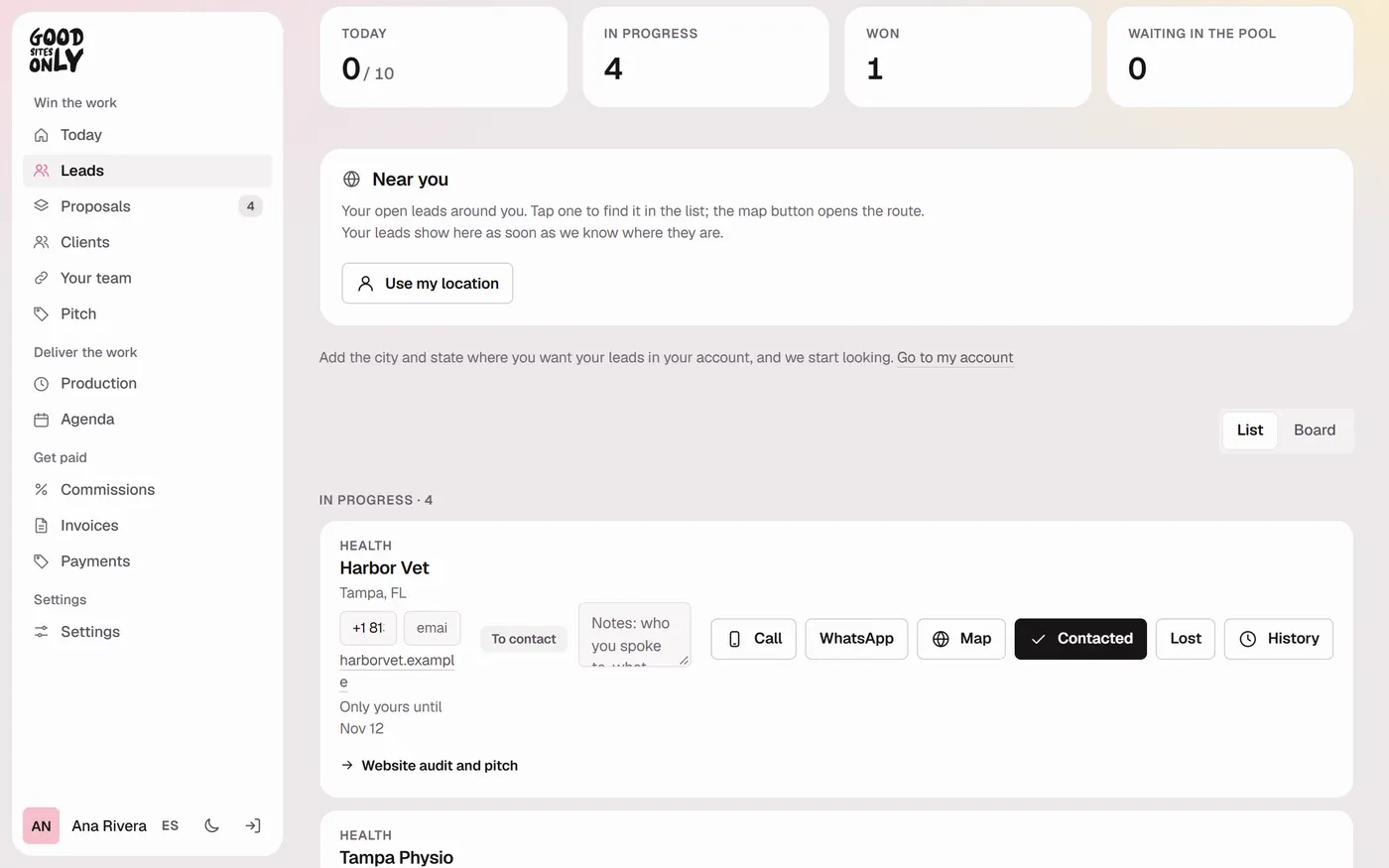
If you sell through our partner program, this step is done for you. Every day your panel receives 5 businesses in your area and your industries with no website, or with one that is broken or outdated, each with its contact details and a review of its site. After your first sale you receive 10 a day, and each business belongs only to you.
How to review a business's website in ten minutes
A specific observation is what separates your call from every other sales call the owner receives. Before you contact a business, look at its site the way a customer would, on your phone:
- Open it on a phone. Does it load quickly? Can you read it without zooming?
- Try to call. Is the phone number visible on the first screen, and does a tap start the call?
- Look for the next step. Is it clear how to book, order or ask for a quote?
- Check the address bar. Does the browser warn that the site is not secure?
- Read the first sentence. Does it say what the business does and where, in plain words?
- Look at the details. An old year in the footer, a menu from years ago, hours that do not match the Google listing.
- Search for it. Search for its service and its city. Does the business appear? Who appears above it?
Choose the one or two findings that cost the owner money, and describe them as a customer would see them. "When I opened your site on my phone, I could not find how to call you" lands better than any technical term. Our partners get this review made for them, on a page they can send to the owner as a gift.
What to say first: phone, WhatsApp and email
Your first message has one goal: to earn a short conversation. It should say who you are, name something real about their business and ask a small question. Leave the price and the sale for later.
On the phone
"Hi, is this Maria? My name is Alex. I work with local businesses in Tampa on their websites. I was looking at yours this morning and noticed that on a phone your number cannot be tapped, so people have to copy it to call you. I made a few notes. Do you have two minutes now, or is there a better time?"
Call at quiet hours for that trade. A restaurant owner cannot talk at lunch, and a dentist's office is calmer in the middle of the morning. If someone else answers, ask who looks after the website and when it is a good time to reach them.
On WhatsApp or by text
"Hi Maria, I'm Alex. I searched for dentists in Tampa and found your clinic. Great reviews. On a phone, your site takes a while to open and your number cannot be tapped. I made you a short review, at no cost. Can I send it here?"
Keep it short enough to read in one glance, and ask permission before you send a link. Write only to business numbers.
By email
Subject: Two things I found on your website
Hi Maria,
Here's a gift for you: a short review of your website.
I found two things that may be costing you calls.
The first: on a phone, your number cannot be tapped.
Can I send you the other one?
Alex
Offer the gift in the first line, because that is the line people see beside the subject. Keep one sentence per line and links short. Every commercial message must follow the rules where you and the business are. In the United States, the CAN-SPAM Act asks for your real identity, a postal address and a way to stop receiving your emails.
How to run the conversation
Once the owner gives you a few minutes, ask before you explain. Their answers will tell you what to offer and how to present it. Five questions cover most of what you need:
- How do most of your new customers find you today?
- What happens when someone visits your website? Do you know if it brings you calls?
- Which of your services would you like to sell more of?
- What have you tried before with your website, and how did it go?
- If your site worked the way you want, what would be different a year from now?
Listen for the words they use, and repeat them when you present. If an owner says "I want the phone to ring more", your whole proposal is about the phone ringing. A business owner buys a result, and the website is the way to get it.
How to show the problem with respect
Many owners built their current site themselves, or paid a relative to do it. Criticizing it is the fastest way to lose the conversation. Describe what a customer experiences, and keep it about the future: "This is what a new customer sees today. Here is what they could see instead."
Then show something concrete. A live design for their industry does more than any description, because the owner can open it on a phone and imagine their own business in it. Our designs are live sites you can send as links.
How to present the price
Present one clear recommendation with one price. Too many options send people away to think. Explain what is included, what happens next and when the site will be online, then stop talking and let the owner respond.
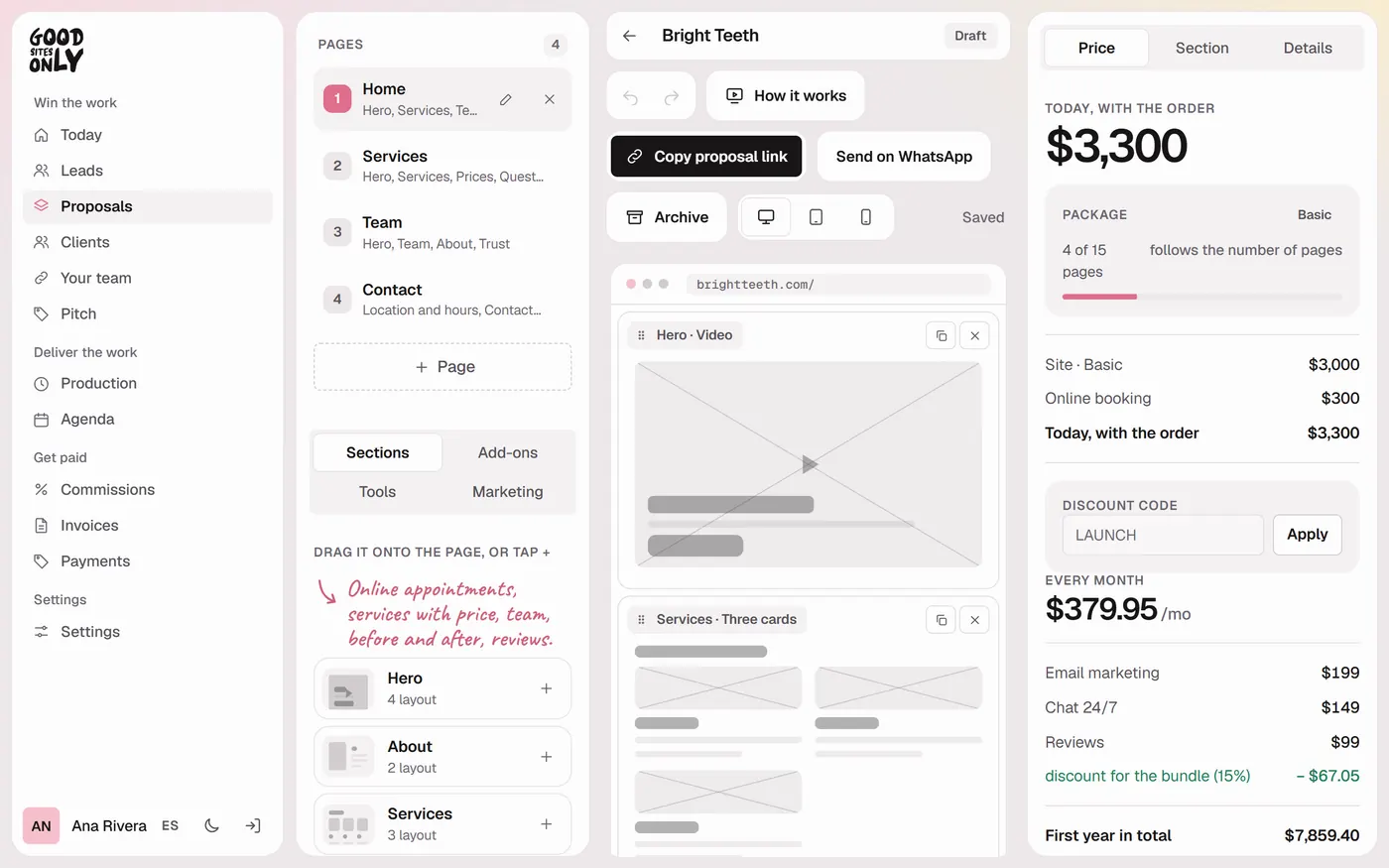
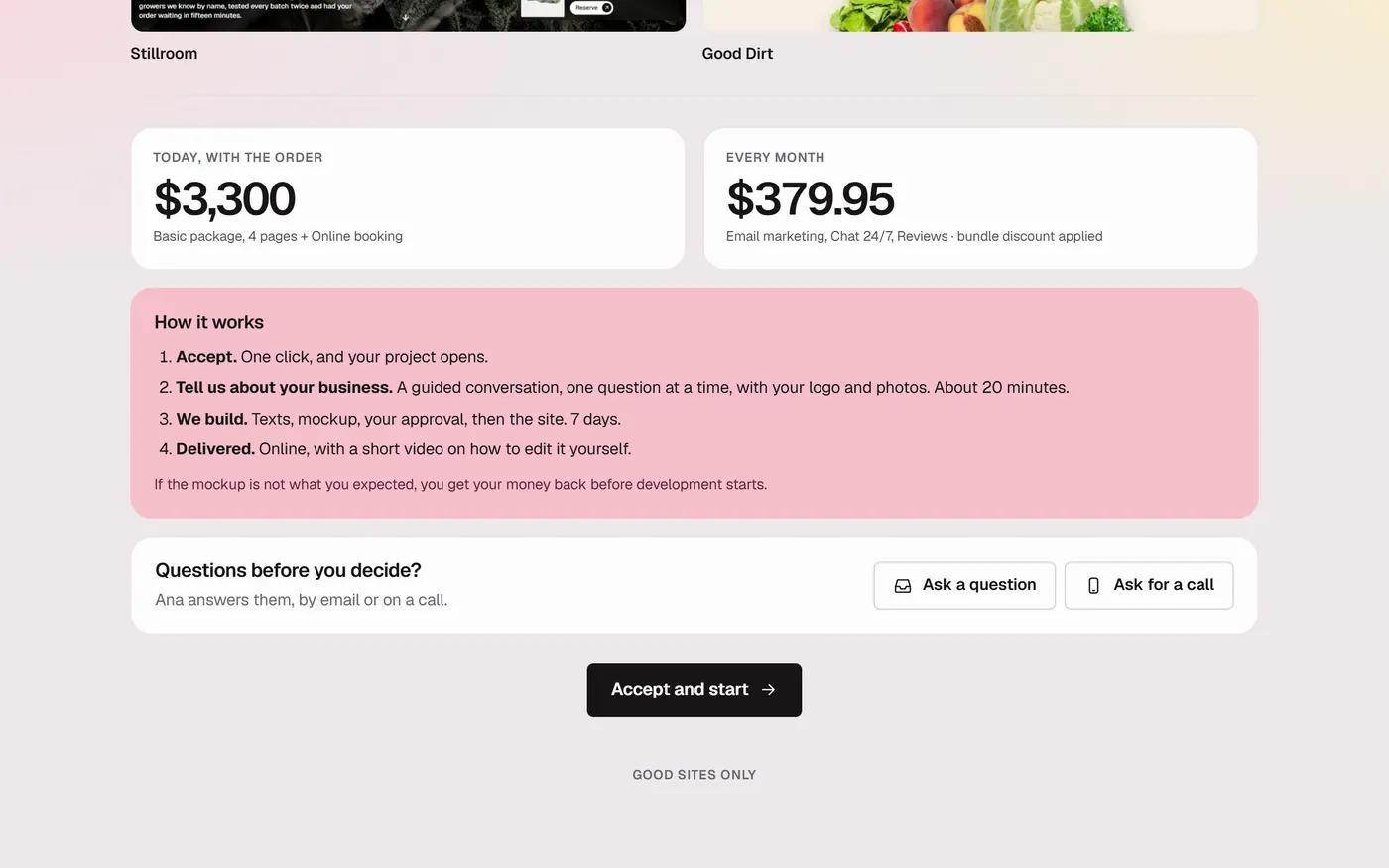
With our platform, you arrange the pages for that business and send the proposal as a link. The client sees their pages, the price and what they can add, and accepts from their phone. The list prices are public on our prices section: $3,000 for up to 15 pages, $5,000 for 15 to 30 pages and $8,000 for more than 30. The price is flat and includes hosting, the texts, a design for their industry and delivery in 7 days.
How to answer the usual objections
Objections usually mean the owner is thinking it over. Answer each one briefly, then ask a question to keep the conversation going.
| What the owner says | What you can answer |
|---|---|
| "It's too expensive." | "I understand. What would one new customer a week be worth to you?" Then compare the price with what a new customer brings in over a year. |
| "I already have a website." | "You do, and it has served you. Here is what a customer sees on a phone today. Would you like to see the difference?" |
| "My nephew does that for me." | "That's great to have. Is your site bringing you the calls you want?" If it is, thank them and move on. |
| "Facebook is enough for me." | "It helps people who already know you. When someone searches for your service on Google, what do they find?" |
| "I don't have time for this." | "That's why it is built this way. You answer a few questions in about 20 minutes, the team writes the texts and you approve each stage." |
| "Send me some information." | "Of course. I'll send you a link with your own pages and the price. Can I call you on Thursday to hear what you think?" |
| "What if I don't like it?" | "You approve the mockup before anything is built. If it is not what you expected, you get your money back before development starts." |
How to follow up without being annoying
Most sales are lost to silence, and owners are busy people. A proposal without a follow-up is usually a proposal forgotten. Keep a simple rhythm and bring something new each time:
- Two days later: ask if the link opened well and whether they had any questions.
- Five days later: share one idea for their business, such as a design from their industry.
- Ten days later: ask directly whether this is still a priority, and make it easy to say no.
- Every month or two: a short, friendly note. Timing changes, and a no today can be a yes in the spring.
When a business opens your proposal, that is the best moment to call. Your panel shows you when it was opened and what the business looked at, and it reminds you of each follow-up.
What happens after the sale
A happy client is your best source of new clients. Stay in touch during the project, and once the site is online, ask for an introduction to another owner they know. A month later is also a good moment to suggest a monthly service, such as Google Business or Reviews, if it fits what they told you at the start.
In our program, the studio takes over after the sale. It works with the client on the questions, the texts and the mockup, and delivers the site in 7 days. You follow each stage from your panel, and your commission goes out the same day we get paid.
Questions about selling websites to local businesses
How do I sell websites to local businesses with no experience?
Start with one industry in one city. Review ten websites, choose one specific problem on each, and contact those owners with that problem. The first conversations teach you what owners care about, and a sales script helps you keep them on track.
Can I sell websites without knowing how to build them?
Yes. Many sellers never touch a site. You work with a studio that builds them, and your job is the conversation and the follow-up.
Which businesses are easiest to sell a website to?
Those with no site or a broken one, good reviews and a service people compare before they call, such as clinics, contractors, salons, gyms and law firms.
What should I say when I call a business about its website?
Say who you are, name one specific thing you noticed on their site and ask for two minutes. Save the price for later, and ask questions before you explain anything.
How much should I charge a small business for a website?
Prices vary widely by market and by what is included. Our list prices are $3,000, $5,000 and $8,000, depending on the number of pages. As a seller you earn 20% of those prices.
How many businesses do I need to contact to make a sale?
There is no fixed number. It depends on your city, your industry and your follow-up. Keep your own count of calls, conversations and proposals, so you learn your own numbers and see where you can improve.
Is cold calling businesses about their website legal?
Rules depend on the country and on the channel. Calling or writing to businesses is generally treated differently from contacting consumers, but check the rules where you and the business are, respect any request to stop, and keep your messages honest. This is general information, not legal advice.
How do I follow up after sending a website proposal?
Write two days later to check that the link opened well, five days later with one useful idea, and ten days later to ask directly whether it is still a priority. After that, a short note every month or two keeps the door open.
Want to start selling? Apply to the partner program